Science as a Force for Progress Part 2: Copernicus and the Sky’s Truth

In the first part of this series, we explored how humanity’s journey from myth to reason laid the groundwork for science as a disciplined pursuit of truth. In part 2 we delve into the dawn of modern science, beginning with Nicolaus Copernicus, whose revolutionary ideas reshaped our understanding of the cosmos. His work is followed by the advancements of Galileo Galilei and the monumental discoveries of Isaac Newton. These discoveries mark a pivotal era where science emerged as a relentless force for progress, challenging the established Christian Church dogma and illuminating the universe’s mechanics.

The Church’s Locked Sky

Nicolaus Copernicus, a Polish astronomer born in 1473, sparked a scientific revolution with a radical idea: the Earth was not the center of the universe. For centuries the geocentric model, championed by Ptolemy and endorsed by the Church, placed Earth at the cosmic core with the Sun, planets, and stars revolving around it. This view aligned with religious doctrine and human intuition. After all, the Sun appeared to move across the sky. But Copernicus, through meticulous observation and mathematical reasoning, proposed a heliocentric model in his seminal work written in 1543, On the Revolution of Celestial Spheres. In this model the Earth and other planets orbited the Sun. It was a simpler and more elegant explanation for the observed motions of celestial bodies.

Image of heliocentric model from Nicolaus Copernicus' De revolutionibus orbium coelestium.
Image of heliocentric model from Nicolaus Copernicus’ De revolutionibus orbium coelestium.

Copernicus’s heliocentrism was not just a new astronomical theory; it was a bold challenge to entrenched authority. The Church was dominant force in medieval Europe, and it viewed the geocentric model as a reflection of divine order. To suggest otherwise risked heresy and death, as Giordano Bruno discovered in 1600. Copernicus was more cautious than Bruno and he published his work late in life, aware of its potential to upend both science and society. His model wasn’t perfect, it still relied on circular orbits and epicycles, but it laid a foundation for future astronomers to build upon. By prioritizing evidence over tradition, Copernicus exemplified science’s power to question assumptions and seek truth, setting the stage for progress that would transform human understanding.

Galileo Galilei, born in 1564, took Copernicus’s ideas and propelled them forward with empirical rigor. Galileo’s improvements made on the newly invented telescope in 1609 was a game-changer. Peering through his lenses, he observed Jupiter’s moons, the phases of Venus, and the Moon’s cratered surface. This was powerful evidence that supported the heliocentric model. The moons of Jupiter, orbiting their planet, suggested that not everything revolved around Earth. Venus’s phases mirrored those of the Moon, consistent with a Sun-centered system. These observations were detailed in works like The Starry Messenger, written in 1610, and provided concrete data that bolstered Copernicus’s theory.

Breaking the Sky Open


Galileo facing the Roman Inquisition

Galileo’s commitment to observation and experimentation marked a leap in scientific methodology. He didn’t just theorize; he tested and refined. His studies of motion laid the groundwork for understanding acceleration and inertia, concepts later formalized by Newton. But Galileo’s outspoken support for heliocentrism led to conflict with the Church. In 1633 he was tried by the Inquisition, forced to recant, and placed under house arrest. Yet his work endured, a testament to science’s resilience. Galileo’s telescopes and experiments showed that progress often comes at a cost, but the pursuit of truth, grounded in evidence, could not be silenced.

The culmination of this era came with Isaac Newton, born in 1643, whose work synthesized and expanded the discoveries of Copernicus and Galileo. Newton’s Principia, written in 1610, is one of the most influential scientific texts ever written. In it he formulated the laws of motion and universal gravitation, providing a unified framework to explain both terrestrial and celestial phenomena. The same force that caused an apple to fall governed the orbits of planets – a profound insight that tied the cosmos together.

Newton’s genius lay in his ability to blend observation, mathematics, and theory. He built on Galileo’s studies of motion and Kepler’s laws of planetary orbits (which refined Copernicus’s model by introducing elliptical orbits). His law of universal gravitation explained why planets followed their paths around the Sun, confirming heliocentrism with mathematical precision. Newton’s work also introduced calculus (co-developed with Leibniz), giving scientists tools to model dynamic systems. From planetary motion to the tides, Newton’s laws provided a blueprint for understanding the universe’s mechanics, cementing science as a predictive and practical force.

Together, Copernicus, Galileo, and Newton represent a transformative arc in human history. Copernicus dared to challenge the cosmic status quo, Galileo provided the observational backbone, and Newton delivered the mathematical framework that made sense of it all. Their work dismantled a worldview rooted in superstition and authority, replacing it with one grounded in evidence, reason, and reproducibility. This was science as progress: a methodical unraveling of the universe’s secrets, each discovery building on the last.

As we transition to Part 3 of this series, From Humors to Heartbeats, we turn our gaze from the heavens to the human body, exploring how science revolutionized medicine. Just as Copernicus upended cosmic assumptions, physicians began to challenge the ancient system of the four humors – a framework that attributed health and disease to imbalances in blood, phlegm, black bile, and yellow bile. At the forefront of this medical revolution was William Harvey, whose discoveries about blood circulation in the early 17th century dismantled centuries-old beliefs. By applying observation and experimentation, Harvey paved the way for modern physiology, proving that science’s relentless pursuit of truth could heal as well as illuminate.

Continue reading Part 3 of Science as a Force for Progress.

1928: Antibiotics

The discovery of antibiotics marked a historic milestone in the history of medicine.  Antibiotics are molecules that kill the growth of bacteria and have led to saving countless lives. As far back as 2500 BCE the Egyptians used moldy bread and plant extractions to treat infection wounds, a practice also used in ancient Greece and China.  The remedies were based on empirical observation rather than an understanding of the underlying biological mechanics.  We sometimes forget the concept of a microorganism as an agent of disease was only developed in the 19th century by Louis Pasteur.

The Dawn of Antibiotics: Alexander Flemming’s Discovery of Penicillin

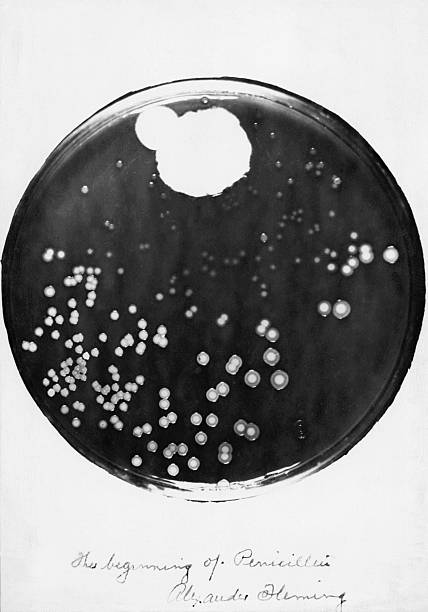
Alexander Fleming's photograph of Staphylococci and Penicillin in a petri dish
Alexander Fleming’s photograph of Staphylococci and Penicillin in a petri dish

The discovery of antibiotics began in 1928 with Alexander Fleming’s accidentally discovery of penicillin. Flemming was Scottish bacteriologist working at St. Mary’s Hospital in London. He was experimenting with the Staphylococcus bacteria, a common bacterium responsible for infections such as boils, sore throats, and abscesses. In the late summer Flemming took a two-week vacation, but he left his lab with unwashed petri dishes. When he returned, he noticed that the petri dishes had been contaminated by a bluish green mold, and around this mold was a clear zone where the bacteria had been eliminated. 

The mold belonged to the genus of fungi called Penicillium. Flemming became intrigued by what he saw and began isolating and experimenting with the mold. He discovered that through a chemical substance the mold secreted, it could kill or inhibit a wide range of harmful bacteria. Furthermore, it left human cells untouched, suggesting that it could be used for safe treatment in the human body. Flemming named the substance Penicillin, after the mold.

In 1929 he published his findings in the British Journal of Experimental Pathology, noting that penicillin was effective against many disease-causing bacteria like streptococcus and meningococcus. However, the substance was unstable and difficult to purify and for nearly a decade the discovery remained largely overlooked by the broader scientific community.

The Oxford Team

Despite this groundbreaking observation, penicillin remained largely ignored by scientists for over a decade. In the late 1930s Howard Florey, an Australian pathologist, and Ernst Boris Chain, a German biochemist, were working at Oxford University. They rediscovered Flemming’s paper and quickly recognized its significance as a naturally occurring antibacterial substance. They faced several challenges including how to grow enough mold, how to extract and purify the ingredient, and proving their ideas could work. An Oxford team was put together, led by Florey, Chain, and Norman Heatley, to overcome these difficult challenges.

The first human trial came in 1941 on a policeman dying of horrific infections.  The officer made an impressive recovery; however, supplies ran out and he died a few days later.  Subsequent trials on wounded soldiers proved unequivocally that penicillin worked miracles where all else failed. World War Two provided an urgent need to develop penicillin as a treatment for soldiers, however British manufacturing was already under heavy strain due to the war. Later that year Florey and Heatley traveled to the United Stats to enlist American pharmaceutical companies and the US government’s support. Within two years, penicillin was being manufactured in quantities sufficient for military use.

The Antibiotic Boom

Penicillin’s success causes a global sensation and the race to discover new antibiotics was on. The post-war age saw an explosion of antibiotic discoveries. Pharmaceutical companies quickly isolated antibiotics from soil microbes, an area that proved to be a treasure trove of new antimicrobial compounds. These new drugs continued to transform medicine by making surgery safer, increasing infant mortality, and assisting in public health. Optimism was sky high in the 1960s that antibiotics could eliminate or reduce many infectious diseases. Their use eventually extended beyond medicine and into agriculture where they were used in animal livestock. However, there were early warnings about their limitations. 

A CDC infographic on how antibiotic resistance (a major type of antimicrobial resistance) happens and spreads.

As early as 1945 Flemming cautioned in his Nobel Prize acceptance speech that bacteria could develop resistance to penicillin if used improperly. This proved to be true. Bacteria can and regularly does evolve resistance to antibiotics, by means of producing enzymes that degrade the drug or alter their cellular targets. Since they reproduce rapidly, going through several generations per day, it allows for a high mutation rate in a short amount of time. In a bacteria population most of the bacteria is low resistance to the antibiotic, but a few may be high resistance. The high resistance bacteria survive and reproduce, over time eventually taking over the population. What began as a population with little to no resistance becomes a population fully resistant to the antibiotic, and a new drug is needed to kill the new resistant bacteria. Overuse in medicine and agriculture accelerated resistance, exposing a critical flaw in the discovery of antibiotics: bacteria adapt faster than new drugs can be developed. Despite this challenge the discovery of antibiotics remains one of humanity’s greatest medical achievements, but its future depends on balancing innovation with responsibility.

Continue reading more about the exciting history of science!