Science as a Force for Progress Part 10: Frontiers Ahead

In the previous part of this series, we explored how Turing, Berners-Lee, and advances in computing and neuroscience created a digital ecosystem that connects minds and accelerates knowledge like never before. In this final part, we reflect on science’s triumphant arc – from centuries dominated by superstition and untestable beliefs to an era of evidence-based mastery over nature’s deepest challenges. Where once plagues were divine wrath and comets omens of doom, today vaccines eradicate diseases and telescopes reveal cosmic truths. As we enter 2026, breakthroughs in quantum computing, biotechnology, fusion energy, space exploration, and artificial intelligence exemplify this shift: replacing fear with understanding, prayer with precision, and limitation with limitless potential. These advances promise to conquer illness, secure sustainable power, unveil the universe, and amplify human intellect – yet they remind us that science’s true power lies in its rigorous, self-correcting pursuit of evidence.

From Superstition’s Shadow to Evidence’s Light

For millennia, humanity attributed misfortune to supernatural forces: earthquakes as godly anger, illnesses as curses, celestial events as portents. Prayers and rituals offered solace but no solutions, leaving life precarious and short. Science overturned this worldview through observation, experimentation, and reproducibility – transforming mystery into mechanism.

Today, this contrast is stark. Where medieval societies blamed miasmas or sin for epidemics, modern microbiology and vaccines, rooted in Pasteur’s germ theory, have nearly eliminated smallpox and dramatically curbed measles. Ancient astrologers read fates in stars; now, telescopes like James Webb pierce cosmic dawn, revealing early galaxies, potential biosignatures on exoplanets, and even a new moon around Uranus in 2025 observations.

Illustration of CRISPR/Cas9 gene editing process.
(Credit: livescience.com)

In health, superstition once prescribed bloodletting or charms; evidence now delivers CRISPR therapies. 2025 saw one-time infusions safely slashing cholesterol by over 50% in high-risk patients via gene editing targeting ANGPTL3, while trials advanced cures for sickle cell, amyloidosis, and rare disorders – building on Watson, Crick, and Franklin’s DNA helix. These are not miracles, but measurable outcomes of methodical inquiry.

A New Era of Discovery

Quantum computing exemplifies progress over prophecy. IBM’s 2025 Nighthawk processor and advancements toward fault-tolerant systems by 2026–2029 promise simulations of molecules for drug design and materials unattainable classically, echoing Curie’s atomic revelations but harnessing them for practical quantum advantage.

Nuclear fusion, long dismissed as eternally distant, advanced decisively: China’s EAST tokamak accessed a “density-free regime” in late 2025, sustaining high-density plasmas for ignition pathways, while global efforts like WEST’s record plasma durations and high-temperature superconductors push toward commercial viability in the 2030s – offering clean, abundant energy without fossil fuels.

Space discoveries further illuminate: Webb’s 2025 views captured supernovae from the universe’s infancy and carbon-rich exoplanet atmospheres hinting at habitability, extending Hubble and Gamow’s Big Bang insights.

An image captured by the James Webb Telescope of galaxies billions of light-years away.
(Credit: livescience.com)

Artificial intelligence accelerates it all. 2025 models excelled on reasoning benchmarks, aiding fusion control, protein design, and hypothesis generation – propelling us toward systems that augment discovery, far from oracles but grounded in data.

From Copernicus repositioning Earth to these revolutions, science has liberated humanity from superstition’s grip, delivering longer lives, interconnected knowledge, and tools to address existential threats. The future gleams with promise: eradicated diseases, limitless clean energy, interstellar exploration, and intelligence beyond biological limits. Yet ethical stewardship—ensuring equitable access, safe AI, and responsible gene-editing demands the same evidence-based rigor.

This series has chronicled science not as arcane facts, but as humanity’s greatest force: dismantling myths, illuminating truths, and empowering progress. Its method – question, test, refine – holds no bounds when guided by curiosity and accountability. In an age where evidence triumphs over enchantment, science lights the way ahead.

Thank you for joining this journey through Science as a Force for Progress.
Science as a Force for Progress Part 9: Digital Dawn and Connected Minds

In the eighth part of this series, we traced how Franklin, Watson, Crick, Hubble, and Gamow decoded the molecular basis of life and the universe’s cosmic origins, linking biological inheritance to the grand scale of existence. In Part 9, we examine the late 20th and early 21st centuries, when computing and global networks transformed information into a ubiquitous force. Alan Turing laid the theoretical foundations for programmable machines, Tim Berners-Lee invented the World Wide Web to connect humanity’s knowledge, and advances in neuroscience and artificial intelligence began mapping and extending the human mind. These developments democratized access to information, accelerated discovery, and augmented intelligence, marking science’s shift toward a digital, interconnected era.

The Analog World Locked in Isolation

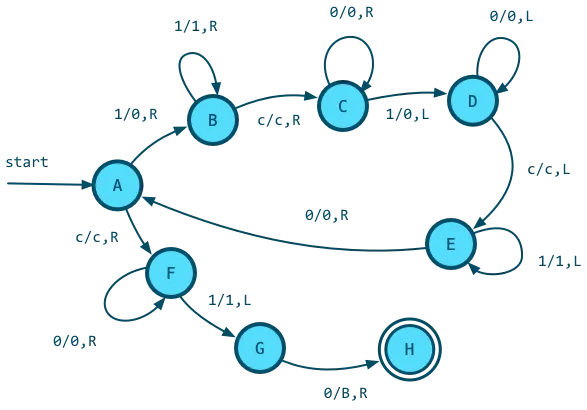
Diagram of a Turing Machine
(Credit: Diagram of a Turing Machine)

Before the digital age, computation was mechanical and limited. It consisted of punch cards, analog devices, and human “computers”, all of which performed calculations slowly. Knowledge was siloed in libraries and institutions, accessible only to the privileged few, while understanding the brain relied on crude observations rather than precise mapping.

Alan Turing, a British mathematician born in 1912, provided the conceptual breakthrough. In his 1936 paper he described a hypothetical “universal machine” capable of simulating any algorithm through a simple tape, read-write head, and instruction table. This became known as the Turing machine, a model that formalized computation as the manipulation of symbols, revealed fundamental limits such as the halting problem, and laid the foundation for computability theory.

During World War II, Turing applied these ideas to crack Enigma codes, hastening victory. His 1950 paper “Computing Machinery and Intelligence” introduced the Turing Test, probing machine intelligence and sparking AI. Postwar designs like the ACE computer realized programmable digital machines.

Breaking the Information Open

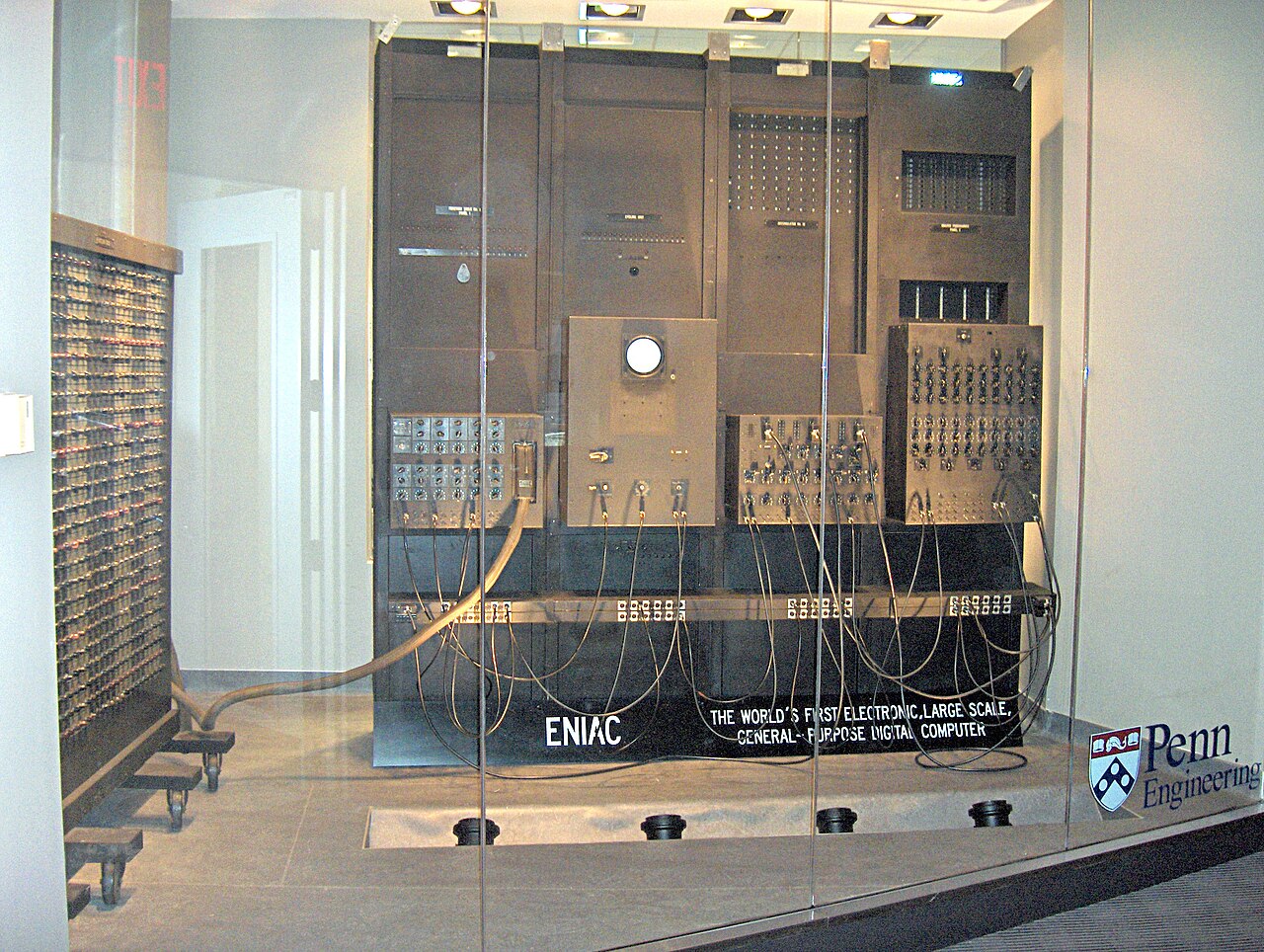
The physical manifestation came swiftly. ENIAC, unveiled in 1946 by Americans John Presper Eckert and John Mauchly, was the first general-purpose electronic computer—programmable, electronic, and vastly faster than predecessors, though room-sized and vacuum-tube based. Transistors and integrated circuits miniaturized computing, leading to personal computers by the 1970s–1980s.

Historical photograph of ENIAC computer.

Tim Berners-Lee, a British computer scientist born in 1955, connected it all. Working at CERN in 1989, he proposed a hypertext system for sharing documents over networks. By 1990–1991, on a NeXT computer, he created HTTP, HTML, URLs, and the first web browser/editor. Releasing it freely in 1993, the Web exploded, turning the Internet into a global repository of knowledge. The power of the internet empowered education, business collaboration, and innovation worldwide.

Parallel progress in mind sciences augmented human cognition. Functional MRI (fMRI) in the 1990s allowed real-time brain activity imaging, revealing neural correlates of thought and emotion. Artificial neural networks, inspired by biology, revived in the 1980s–2010s with deep learning, enabling machines to learn patterns, powering image recognition, translation, and AI like modern language models.

Turing theorized universal computation, early computers and the Web realized interconnected information, while neuroscience and AI extended mental capabilities. Their legacies are rooted in logic, engineering, and biology. It created an information ecosystem that accelerates all sciences, fosters global progress, and redefines human potential.

As we conclude this series in Part 10, Frontiers Ahead, we reflect on science’s ongoing trajectory and future promises. From quantum computing to gene editing and sustainable energy, the method of evidence-based inquiry continues to drive humanity forward, building on centuries of relentless curiosity.

Continue reading Part 10 of Science as a Force for Progress.
Science as a Force for Progress Part 8: Codes of Life and Cosmic Origins

In the seventh part of this series, we witnessed how Curie, Einstein, and Bohr unraveled the atom and spacetime, introducing revolutions in energy, matter, and reality that powered modern technology. In Part 8, we explore mid-20th-century breakthroughs that decoded the blueprint of life and traced the universe’s birth. Rosalind Franklin’s pivotal imaging, followed by James Watson and Francis Crick’s model of DNA, unveiled heredity’s mechanism, while Edwin Hubble’s observations and George Gamow’s theories established the expanding universe and Big Bang. These discoveries bridged biology and cosmology, replacing static or divinely fixed views with dynamic, evidence-based narratives of evolution.

The Codes of Life and Origins of the Universe Locked in Mystery

For centuries, both the diversity of life and the origins of the universe itself were shrouded in myth and religious doctrine rather than empirical inquiry. Heredity was speculated upon through ideas like “bloodlines” or blending inheritance, with no grasp of its material foundation. Similarly, the cosmos was often regarded as eternal and unchanging, or created in a finite act of divine will.

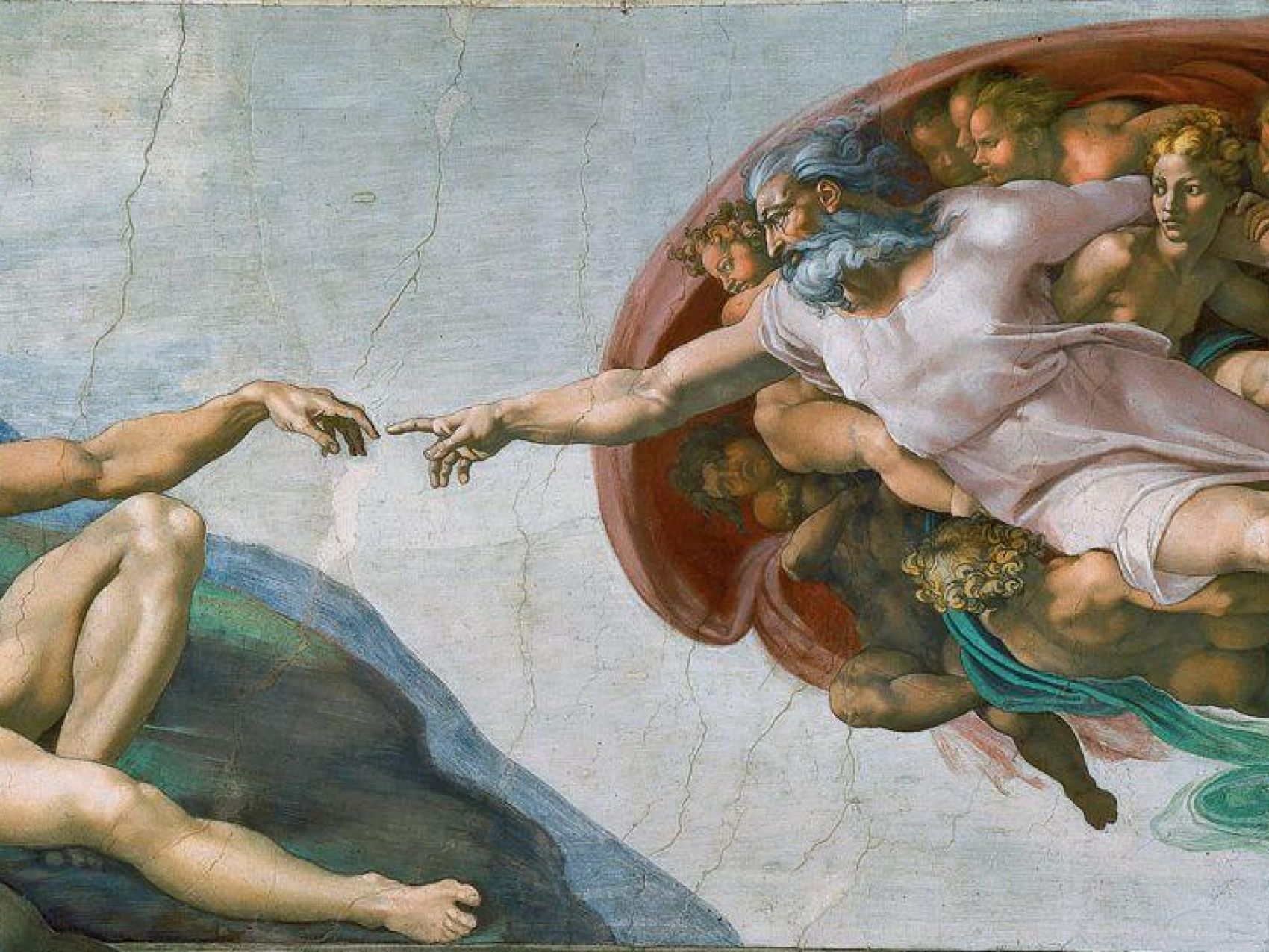
Illustration depicting the biblical Creation story from Genesis.

Many cultures explained universal origins through creation myths: ancient Egyptians envisioned the god Atum emerging from primordial waters to create the world, while Norse mythology described a void giving rise to ice and fire forming the first beings. Abrahamic traditions, influential in Western thought, held to a literal six-day creation as described in Genesis, with the universe and all life formed ex nihilo by divine command – a static, young cosmos centered on humanity. Even into the 20th century, some scientific models like the steady-state theory proposed an infinite, eternal universe in perfect balance, continuously creating matter to maintain density amid expansion—avoiding a beginning that might imply a creator. These views, whether mythological or theoretical, lacked testable mechanisms and often aligned with philosophical or theological preferences for an unchanging or purposefully designed reality.

The molecular era began with Rosalind Franklin, a British crystallographer born in 1920. At King’s College London in the early 1950s, Franklin perfected X-ray diffraction techniques on DNA fibers. Her famous Photograph 51 revealed a clear X-pattern, indicating a helical structure with precise dimensions. This was crucial evidence that DNA was not a random coil but an ordered double helix. Though her contributions were underrecognized in her lifetime (she died in 1958), Franklin’s data provided the empirical foundation for decoding life’s code.

Breaking Open the Codes of Life and the Origins of the Universe

James Watson, an American biologist born in 1928, and Francis Crick, a British physicist born in 1916, at Cambridge University, built directly on this. Using Franklin’s measurements and Chargaff’s base-pairing rules, they constructed a physical model in 1953: DNA as a double helix of sugar-phosphate backbones with complementary base pairs (A-T, G-C) connected by hydrogen bonds.

This elegant structure explained replication (helices unzip, each strand templates a new partner) and mutation, unifying genetics with chemistry. Their 1953 paper revolutionized biology, enabling the genetic code’s cracking, biotechnology, and medicine—from CRISPR to personalized treatments.

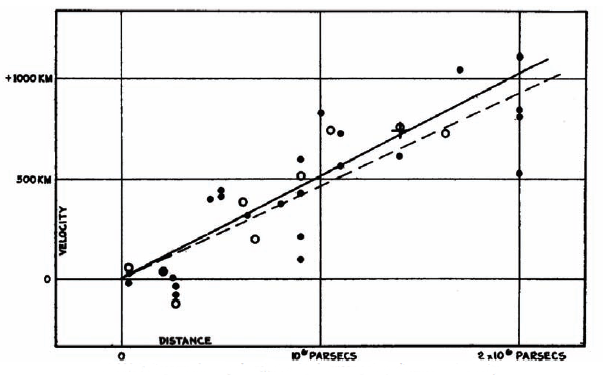
In cosmology, Edwin Hubble, an American astronomer born in 1889, transformed our view using the 100-inch Hooker Telescope at Mount Wilson. In the 1920s, he measured galaxies’ distances via Cepheid variables and their redshifts—light stretched by motion away from us. His 1929 plot showed velocity proportional to distance: the farther the galaxy, the faster it recedes.

Hubble's original diagram showing the velocity-distance relation (redshift).
Hubble’s original diagram showing the velocity-distance relation (redshift).
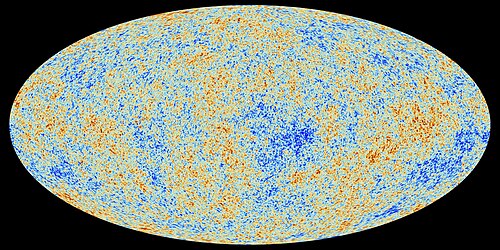
Map of the cosmic microwave background radiation.
(Credit: Wikipedia)

George Gamow, a Ukrainian-American physicist born in 1904, formalized this in the 1940s as the Big Bang theory: the universe began approximately 13.8 billion years ago in a primordial explosion, cooling to form matter. With Ralph Alpher and Robert Herman, he predicted “relic radiation” – the cosmic microwave background (CMB), discovered in 1965 by Penzias and Wilson.

Franklin, Watson, Crick, Hubble, and Gamow decoded profound mysteries. The DNA trio revealed heredity’s mechanism, while Hubble and Gamow traced cosmic origins. Their work, rooted in observation, data, and theory, fueled genetics revolutions and modern astronomy, linking life’s evolution to the universe’s.

As we approach Part 9 of this series, Digital Dawn and Connected Minds, we turn to the late 20th and early 21st centuries, where computing and networks amplified science’s reach. Just as Watson and Crick modeled DNA, pioneers like Alan Turing and Tim Berners-Lee built information systems, while neuroscience and AI began decoding consciousness and extending human intellect.

Continue reading Part 9 of Science as a Force for Progress.

Science as a Force for Progress Part 7: Atoms, Quanta, and the Fabric of Reality

In the sixth part of this series, we explored how Darwin, Pasteur, Koch, and Maxwell revealed hidden mechanisms of life and electromagnetism, extending science’s explanatory power into biology and physics. In Part 7, we enter the early 20th century, a period of profound upheaval that dismantled classical views of matter, energy, and reality itself. Pioneers like Marie Curie, Albert Einstein, and Niels Bohr (along with contemporaries in quantum theory) probed the subatomic world and spacetime, introducing radioactivity, relativity, and quantum mechanics. These revolutions challenged deterministic certainty, unlocked immense energy, and reshaped technology, medicine, and philosophy.

The Classical World Locked in Stability

At the dawn of the 20th century, physics seemed nearly complete. Matter was thought to consist of indivisible atoms in a continuous, predictable universe governed by Newton’s laws. Energy flowed smoothly, and light was a wave in an ethereal medium. Yet anomalies such as blackbody radiation and the photoelectric effect defied explanation, hinting at deeper mysteries.

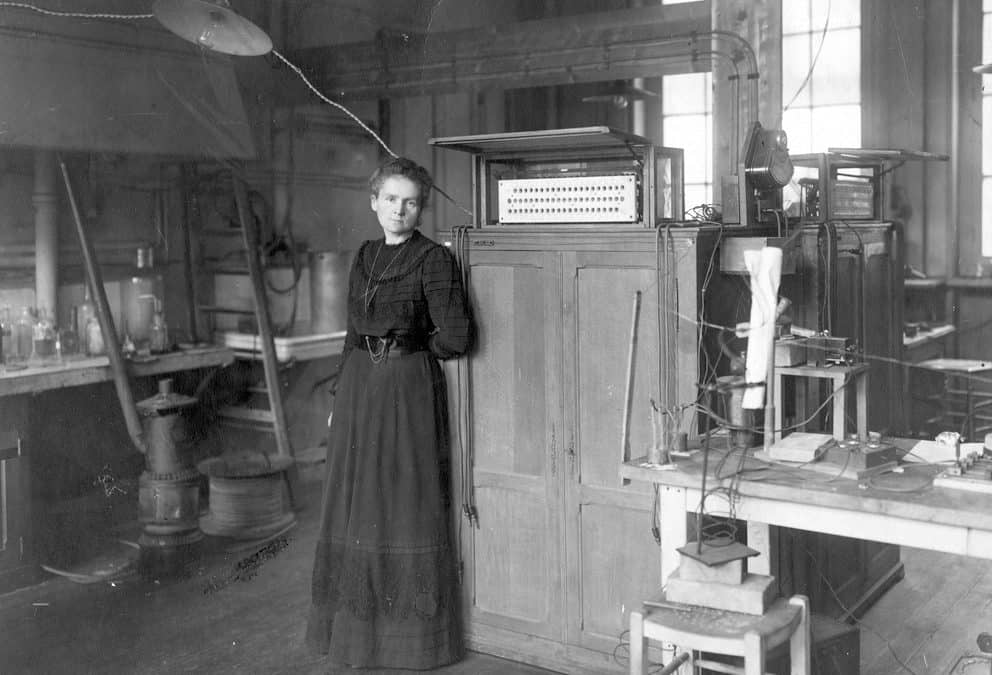
Marie Curie in her laboratory in Paris.

Marie Curie, a Polish-born physicist born in 1867, ignited the atomic era with her groundbreaking work on radioactivity. Building on Henri Becquerel’s discovery of uranium rays, Curie and her husband Pierre isolated radium and polonium from pitchblende ore through painstaking chemical separations. Her 1903 thesis and dual Nobel Prizes (Physics in 1903, Chemistry in 1911) established radioactivity as the spontaneous emission of particles and energy from atomic nuclei.

Curie’s discoveries not only revealed atomic instability but enabled practical applications, from cancer treatments (radium therapy) to X-ray technology in World War I. Though she succumbed to radiation exposure, her work dismantled the notion of inert atoms, opening the door to nuclear physics and energy.

Breaking Open the Secrets of the Atom

Albert Einstein, a German-born theorist born in 1879, shattered classical intuitions in 1905 – his “miracle year.” In special relativity, he showed that space and time are intertwined, varying with velocity, and that nothing exceeds light speed. His iconic equation, E=mc², demonstrated mass-energy equivalence, implying vast energy locked in matter.

In general relativity (1915), Einstein redefined gravity as spacetime curvature caused by mass, predicting phenomena like light bending and confirmed in 1919. His explanations of the photoelectric effect (earning the 1921 Nobel) introduced light quanta (photons), bridging to quantum theory and enabling solar cells and electronics.

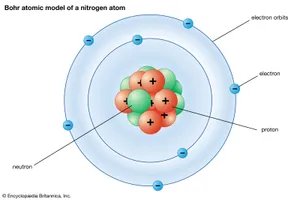
Diagraph of Bohr's Model of the Atom.
Diagraph of Bohr’s Model of the Atom.
{Credit: Britannica Encyclopedia)

The quantum revolution culminated with Niels Bohr, a Danish physicist born in 1885. In 1913, Bohr refined Rutherford’s nuclear atom model by quantizing electron orbits: electrons jump discrete energy levels, emitting or absorbing specific light wavelengths. This explained atomic spectra that classical physics could not. Though later superseded, Bohr’s model incorporated Planck’s quanta and paved the way for full quantum mechanics in the 1920s by Heisenberg, Schrödinger, and others, revealing probabilistic reality at small scales.

Curie, Einstein, and Bohr (with quantum pioneers) unraveled the fabric of reality. Curie exposed atomic power, Einstein unified space, time, and energy, and Bohr quantized the atom. Their theories, grounded in experiment and mathematics, enabled nuclear power, GPS, semiconductors, and lasers, while humbling humanity’s classical worldview.

As we move to Part 8 of this series, Codes of Life and Cosmic Origins, we examine mid-20th-century triumphs that decoded heredity and the universe’s birth. Just as Einstein curved spacetime, scientists like Rosalind Franklin, James Watson, and Francis Crick unveiled DNA’s double helix, while Edwin Hubble and George Gamow traced the Big Bang. Science’s quest continued, merging micro and macro scales to illuminate life’s blueprint and cosmic evolution.

Continue reading Part 8 of Science as a Force for Progress.