In the sixth part of this series, we explored how Darwin, Pasteur, Koch, and Maxwell revealed hidden mechanisms of life and electromagnetism, extending science’s explanatory power into biology and physics. In Part 7, we enter the early 20th century, a period of profound upheaval that dismantled classical views of matter, energy, and reality itself. Pioneers like Marie Curie, Albert Einstein, and Niels Bohr (along with contemporaries in quantum theory) probed the subatomic world and spacetime, introducing radioactivity, relativity, and quantum mechanics. These revolutions challenged deterministic certainty, unlocked immense energy, and reshaped technology, medicine, and philosophy.
The Classical World Locked in Stability
At the dawn of the 20th century, physics seemed nearly complete. Matter was thought to consist of indivisible atoms in a continuous, predictable universe governed by Newton’s laws. Energy flowed smoothly, and light was a wave in an ethereal medium. Yet anomalies such as blackbody radiation and the photoelectric effect defied explanation, hinting at deeper mysteries.
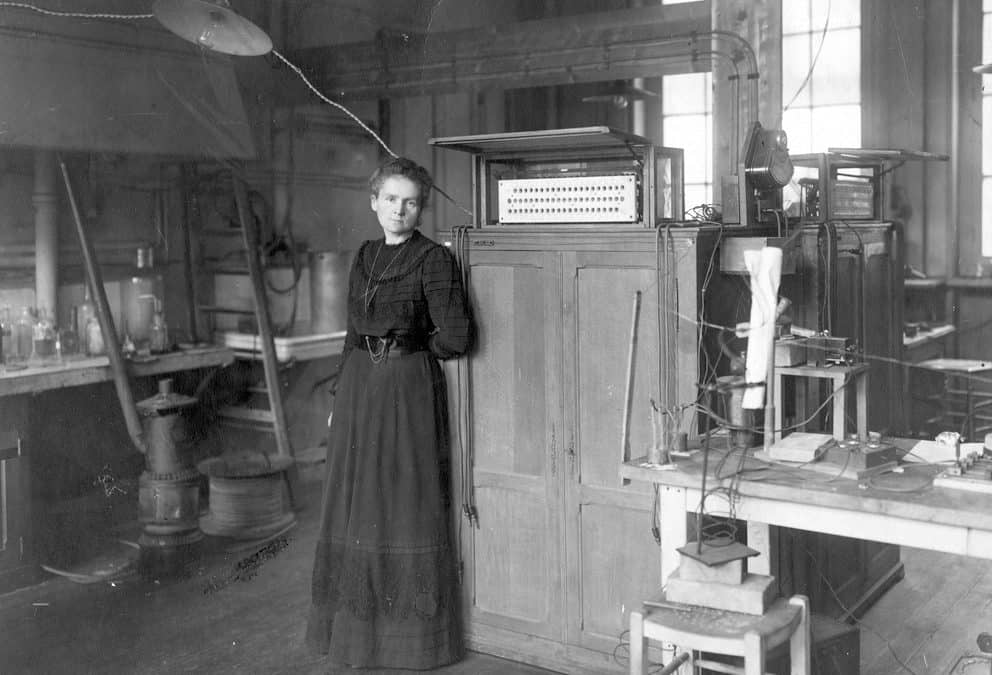
Marie Curie, a Polish-born physicist born in 1867, ignited the atomic era with her groundbreaking work on radioactivity. Building on Henri Becquerel’s discovery of uranium rays, Curie and her husband Pierre isolated radium and polonium from pitchblende ore through painstaking chemical separations. Her 1903 thesis and dual Nobel Prizes (Physics in 1903, Chemistry in 1911) established radioactivity as the spontaneous emission of particles and energy from atomic nuclei.
Curie’s discoveries not only revealed atomic instability but enabled practical applications, from cancer treatments (radium therapy) to X-ray technology in World War I. Though she succumbed to radiation exposure, her work dismantled the notion of inert atoms, opening the door to nuclear physics and energy.
Breaking Open the Secrets of the Atom
Albert Einstein, a German-born theorist born in 1879, shattered classical intuitions in 1905 – his “miracle year.” In special relativity, he showed that space and time are intertwined, varying with velocity, and that nothing exceeds light speed. His iconic equation, E=mc², demonstrated mass-energy equivalence, implying vast energy locked in matter.
In general relativity (1915), Einstein redefined gravity as spacetime curvature caused by mass, predicting phenomena like light bending and confirmed in 1919. His explanations of the photoelectric effect (earning the 1921 Nobel) introduced light quanta (photons), bridging to quantum theory and enabling solar cells and electronics.
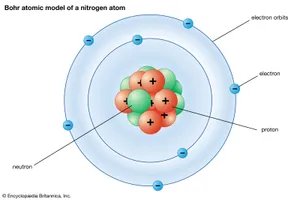
{Credit: Britannica Encyclopedia)
The quantum revolution culminated with Niels Bohr, a Danish physicist born in 1885. In 1913, Bohr refined Rutherford’s nuclear atom model by quantizing electron orbits: electrons jump discrete energy levels, emitting or absorbing specific light wavelengths. This explained atomic spectra that classical physics could not. Though later superseded, Bohr’s model incorporated Planck’s quanta and paved the way for full quantum mechanics in the 1920s by Heisenberg, Schrödinger, and others, revealing probabilistic reality at small scales.
Curie, Einstein, and Bohr (with quantum pioneers) unraveled the fabric of reality. Curie exposed atomic power, Einstein unified space, time, and energy, and Bohr quantized the atom. Their theories, grounded in experiment and mathematics, enabled nuclear power, GPS, semiconductors, and lasers, while humbling humanity’s classical worldview.
As we move to Part 8 of this series, Codes of Life and Cosmic Origins, we examine mid-20th-century triumphs that decoded heredity and the universe’s birth. Just as Einstein curved spacetime, scientists like Rosalind Franklin, James Watson, and Francis Crick unveiled DNA’s double helix, while Edwin Hubble and George Gamow traced the Big Bang. Science’s quest continued, merging micro and macro scales to illuminate life’s blueprint and cosmic evolution.