5500 BCE – 5000 BCE: Metallurgy

The importance of metallurgy to human culture is so vital that scholars typically divide ancient time periods by metalworking ages such as the Stone Age, the Bronze Age, and the Iron Age.  Metallurgy is the process of extracting metals from their ores and modifying them for human use. These early usages resulted in the production of hardened weapons and armor, tools, utensils, pottery and more.  The role of metallurgy is even more important in the industrialized present-day. It has essential uses in machines, buildings, electronics, and in our transportation systems.

The Origination of Metallurgy
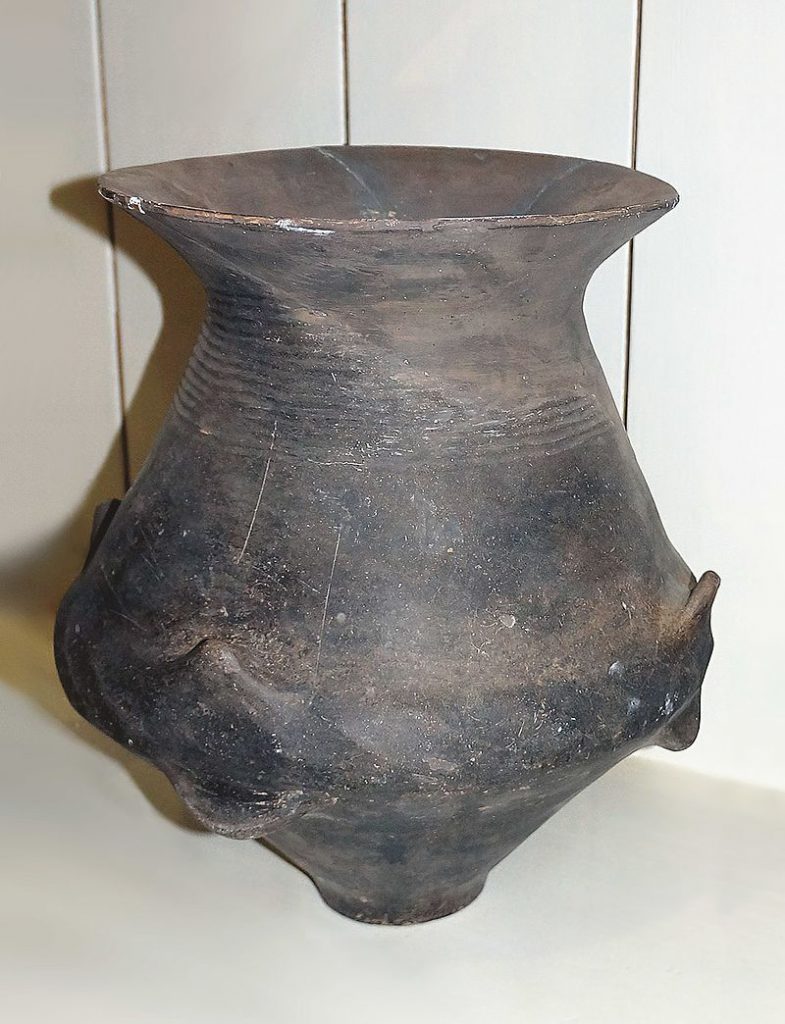
Early metalluargy
Early Metallurgy

Years before metals were valued for their usage they were valued for their natural beauty. In time it was found that metals could be molded into different forms to serve some practical use.  The earliest evidence for smelting, the process of extracting an metal by heating an ore, was found in the Balkans and Western Asia around 7500 years ago. The first metals smelted were tin and lead, followed by copper.

Eventually metals were mixed together to create stronger alloys. Alloys are new metals containing greater strength and durability that are made of two more more metals. Combining tin with lead in the right proportions produced bronze which was significantly harder than copper.  Exactly how this was discovered is unknown, but happened probably by accident or through trial and error. However it is certain that the intentional mining of tin to produce bronze was happening by around 2000 BCE.

Metallurgy technology provided significant advantages to the peoples who figured it out. Civilizations that mastered this technology obtained a competitive advantage over their neighbors, and created essential industries such as mining and blacksmithing.

The First Metals Used by Humans

There were seven metals used by ancient human civilizations. These were gold, silver, tin, lead, copper, iron, and mercury. Of those seven metals only gold is found in a natural state. There rest were mixed in with ore’s and had to be melted out, a process called smelting. The first metals to be smelted were lead and tin. A simple campfire was hot enough for this to work although neither metal was strong enough to provide much practical usage in buildings or weapons. The same is true for gold and silver which were used for adornment in jewelry and ornaments.
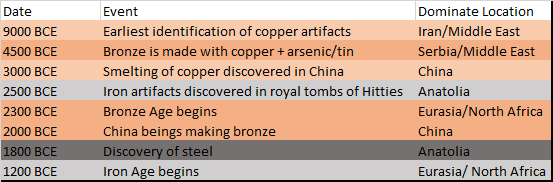
Metallurgy Timeline

Copper is stronger than both tin and lead, but it requires higher temperatures than an open fire to be smelted. The heat needed to be insulated by a kiln, which is basically like an oven. The earliest known discovery of copper smelting occurred around 5500 BCE in the Fertile Crescent. While copper is stronger than tin and lead it still was not very useful in making weapons and structures. Copper weapons were soft and dulled very quickly. Like gold and silvery it was first used for its aesthetic value but later used for pottery to make items such as pots, cups and trays.
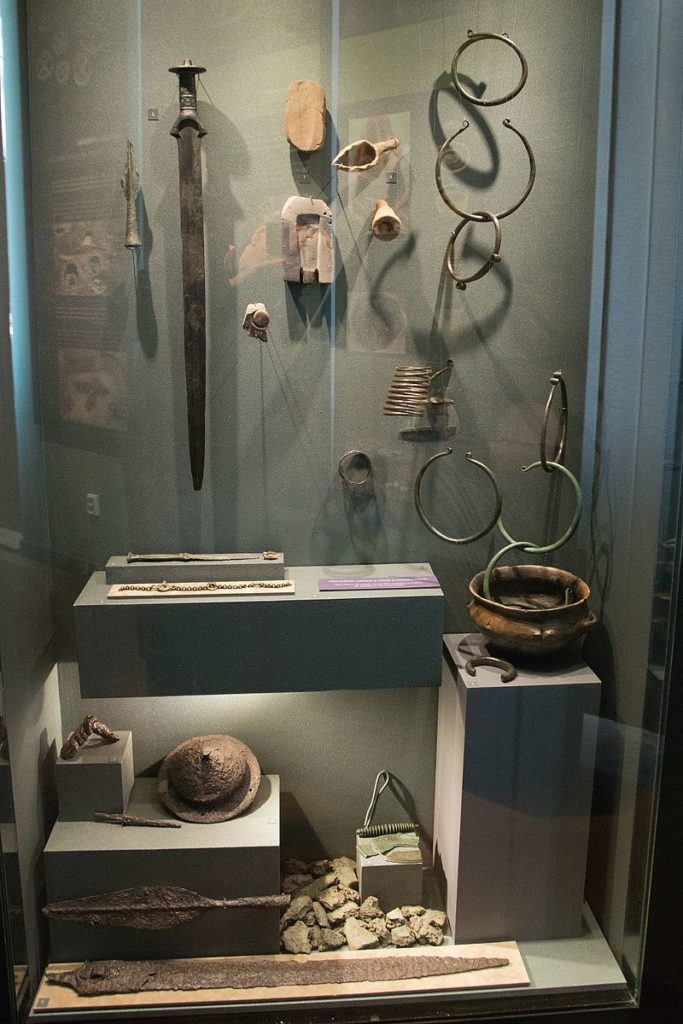
Metallurgy of Bronze age weapons and tools
Bronze Age Weapons and Tools
(Credit: Wikimedia Commons)

After using copper for about a thousand years early civilizations discovered ways to improve the metal. They created bronze alloys. Bronze made by combining copper other materials, but it was typically arsenic or tin. Bronze alloys of arsenic were used first, followed by a stronger and more durable alloy of tin. The proportions of copper to tin varied but the most common proportion was 8-1, or about 87.5% copper to 12.5% tin. Bring stronger, bronze was quickly used in the creation or improvement of additional tools, weapons, currency, and building structures. It was the dominate metal used during 2300 BCE until 1200 BCE iron became widespread.

Iron was relatively rare until about 1200 BCE when large scale iron production began. The Hittites of Anatolia (present day Turkey) are recognized as being the first civilization to smelt iron, although like most things in ancient history this is debated. After they were conquered the technology quickly spread around the Mediterranean and Northern Africa then into India and Asia. Iron is significantly stronger than bronze however it requires a much higher temperature to melt and mold. Smelting iron therefore required specially designed furnaces to melt and cast the metal. Metallurgy in human culture did not stop with iron and the Iron Age, it was only the beginning.

Metallurgy Today

The improvement of metals for human benefit continues to this day. Steel combines iron with charcoal and is one of the most important material used in the modern worlds large building structures. Many new processes have been invented to cut, mill, grind, and join metals into stronger, lighter and more durable materials.

Continue reading more about the exciting history of science!

1.5 Million – 400,000 Years Ago: Fire Power

At some point in history there had to be one initial crucial step that separated humans from the other animals in our journey to becoming the dominant species on this planet.  I will call that point the beginning of science and label it by humans ability to control fire. The ability to control fire was a turning point in human evolution.

The Benefits of Controlling Fire

Fire Power

Sometime in our ancestor’s very ancient past, and certainly by 400,000 years ago, fire came under human control.  By this time the archeological record is full of heat altered artifacts. Control of fire in human evolution was beneficial for a variety of novel reasons. These benefits include:

  1. Provided protection from predators and assisted in hunting prey.
  2. Provided warmth which allowed people to live in cooler regions of the planet
  3. Assisted in tool making
  4. Ceremonial usages
  5. Allowed people to see at night
  6. Provided us with the ability to cook food
  7. Provided groups with a “nest” – the campsite

Protection from predators and used in hunting prey

In the struggle for survival, fire was used both defensively and offensively. Fire can be used as a deterrent because it often scares away animals. Additionally, there is evidence that first accidental and then controlled fires were used to scorch large areas of land for food. During the blaze many animals inevitably perished in the inferno. Our early humans ancestors could then walk in and “fire harvest” many of the small animals and eggs for food. These large scale fires would also create chance cooking, a prequel of intentional cooking as it led to the food being more easily digestible. Fires would also cause larger animals to flee out into the open making them easier to kill.

Fire provides warmth

Humans are well adapted to living in warmer climates but are much less well adapted to living in colder regions. The obvious reason is that we have lost much of the hair on our body. Without fur we needed another way to stay warm. Staying close to a fire allows us to survive during cooler nights and in cooler regions during the winter season.

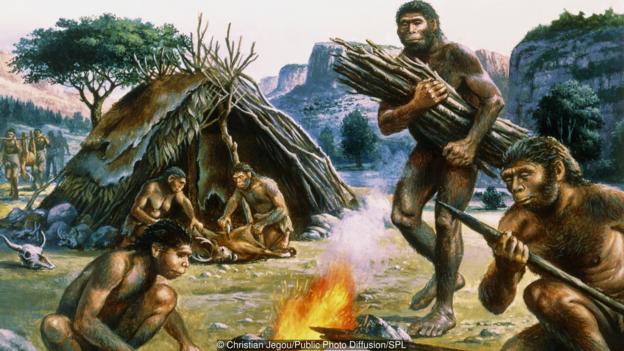
Every human evolution: Homo Erectus using fire to make tools
Homo Erectus Using Fire to Make Tools
(Credit: Christian Jegou/Public Photo Diffusion/SPL)

Fire assists in tool-making

Fire allowed the forging of tools. The is evidence that Neanderthals used fire in shaping wood tools. Although wood from hundreds of thousands of years ago would not last to the present day it is likely that our ancestors would have done the same. Stone and bones last much longer than wood. There is evidence for deliberate heat altered stone and bone artifacts as far back as 1,000,000 years ago in caves across Africa. The artifacts would have been used for weapons such as a spear, or a digging stick for a food gatherer.

Fire in ceremonial usage

The raw power of fire would have been inspiring to our ancient ancestors. There is evidence that it was used in ceremonials services of sacrifices, offerings, or devotion. We still see candles displayed in many ceremonies today.

Night vision

Controlling fire allowed people to see at night. Being able to see at night adds to the time that people can be productive. It also meant people could travel much more safely at night.

Cooking food

Cooking food may have been a significant step in leading humans to the top of the food chain and even to increasing brain size, although hominid brain size was increasing before cooked food became common in early humans.  In any case, what is indisputable is that cooking food killed the parasites that infested food, allowing for easier digestion. This enabled our human ancestors to make due with smaller teeth and shorter intestines.  It is hypothesized that a smaller intestine was the factor in allowing for a larger, jumbo brain of sapiens and Neanderthals, since both the brain and the digestive tract are two are the largest energy consuming organ systems in the body.  By shortening the digestive tract it enabled the energy economy of the body to devote more resources to a jumbo human brain.

The campsite

The campsite is also believed to have functioned as a “nest” for our ancestors and therefore played a pivotal role in the evolution of our sociability.  All animals that exhibit sociability have a nest, which allow for a common place for the species to gather and stay at. Evidence of campsites exists from about 400,000 – 300,000 years ago in varying sizes and contexts.

Control of fire was a turning point in human evolution. The process happened gradually through increasing interaction with natural fires. Accidentally cooked meat provided a new sources of calories and protein that was easily digestible. A fortuitously shaped burnt stone in the shape of a sharp point would have been used for hunting or digging. Eventually our ancestors learned to control fire and made these things deliberately. We used the power of fire to forge the metals that made our tools and building structures. The benefits to our species of fire use cannot be overstated in the physical, social, and cultural realms.

A Brief Video on The Discovery of Fire

Continue reading more about the exciting history of science!
1610: The Starry Messenger

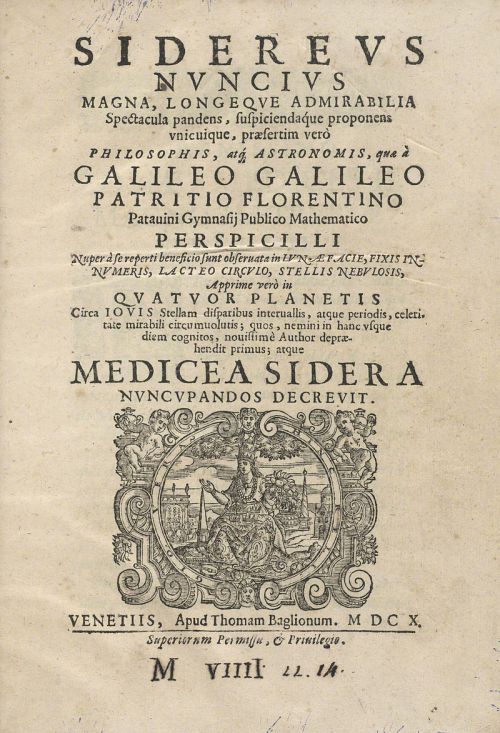
Starry Messanger (Sidereus Nincius
Starry Messenger
(Credit: Wikimedia Commons)

Scientific discoveries often progress step by step with technological improvements. The invention of the telescope in 1608 by Dutch spectacle makers provided the tool need to transform astronomy.  Word spread quickly of this new invention, and by April 1609 one could be purchased in eyeglass shops in Paris.  Later that same year it spread into Italy, where word of it came to the Italian polymath Galileo Galilei.  Galileo did not actually see a telescope, but based on its description he went ahead with the task of creating his own.  He vastly improved the instrument allowing for some of the most revolutionary and groundbreaking discoveries in the history of science.

It didn’t take very long for Galileo to make his discoveries known. Published by Galileo in 1610, Sidereus Nuncius (or Starry Messenger) revealed to the world his observations as he viewed the night sky through his improved telescope.  These new observations and discoveries changed how we viewed the composition of the universe and our place among the cosmos.  Unfortunately for Galileo at the time, they came in direct contradiction with Aristotelian cosmology, Ptolemaic astronomy, and the most significantly the theological teachings of the Roman Catholic Church. The evidence presented in the book sided more with the Copernican System of the universe, placing the Sun at the center of the Solar System.

The Starry Messenger and its Findings

The Starry Messenger is a short book of about 60 pages written in Latin by Galileo, published on March 13, 1610. It is historically important not only for its shocking content, but it was the world’s first scientific publication derived from telescope observations. The book consists of an introduction, some observations made by Galileo through his telescope, and his conclusions based on those observations. Galileo also included dozens of supplementary drawings of his observations. Despite its brevity, the impact of the work was profound.

Let’s take a look at some of the profound observations and conclusions of the Starry Messenger

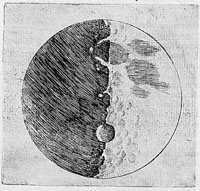
Sketch of the Moon with its visible craters from Sidereus Nuncius.
  • Craters and Mountains on the Moon:  Galileo’s observations showed mountain and valleys present on the moon.  He could even estimate the height of the mountains  based on the length of their shadows.  These observations contradicted the accepted wisdom of Aristotle and the cosmology of Ptolemy that taught that the moon and other heavenly bodies were perfect spheres.  It proved there could be other worlds similar to Earth.
  • The Discovery of Four of Jupiter’s Moons:  Galileo noticed four points of light following and orbiting around Jupiter, which he deduced as moons.  This further reinforced that the Earth is not the center of everything.
  • Many additional stars in the night sky:  Galileo was able to observe hundreds of stars behind the stars visible by the naked eye.  This showed unequivocally that the stars were not fixed, and that the universe was far larger than most people had previously imagined.

Galileo also made some other startling discoveries around this time that were not published in his book.  These observations included:

  • Sunspots: Galileo observed many dark spots on the Sun that moved and changed in shape and size over time.  He was able to see that the Sun itself was rotating.  These were published later in a different work titled “Letters on Sunspots” in 1613.
  • The Phases of Venus:  The order of phases and changes in diameter of Venus proved conclusively that Venus orbited the Sun.  This proved that the Earth is not the center of the universe and that the Sun was also a center of motion. These were also published in his work “Letters on Sunspots” in 1613.

Questioning the Established Dogma with Empirical Evidence

The publication of this book began the process of upending the long-held ideas of Aristotelian cosmology and Ptolemaic astronomy by providing evidence for heliocentrism and the Copernican System.  Clearly the Earth was not the center of the universe.   Clearly the revered heavenly bodies were not perfect spheres.  And clearly the universe was far larger than anyone had previously imagined.  These discoveries quickly made Galileo famous across Europe.  Indeed, Galileo sought out fame. He dedicated the four satellites orbiting Jupiter to Cosimo de Medici II, Grand Duke of Tuscany, naming them the “Medicean Stars” after Cosimo’s family name. But the fame coupled with his arrogant personality also also brought him enemies.  It marked the beginning of his famous troubles with the Catholic Church as heliocentrism was at the time in direct conflict with Christian theology. 

In 1616 Galileo was called before Cardinal Robert Bellarmine and warned to cease his teachings of heliocentrism.  It was determined at this meeting that the Sun being placed at the center of the universe was heretical and that mobility of the Earth was in contrast to theology. For a time, Galileo stayed away from teaching and promoting the Copernican System. However, eight years later Galileo published a book defending the Copernican System titled A Dialogue on the Two Chief World Systems.  This work further infuriated Church as it seemed to mock the Pope as a simpleton and in 1633 Galileo was brought before the Roman Inquisition to stand trial for his supposed heresies.  Threatened with torture and ridicule, Galileo was ultimately forced to plead guilty and spent the rest of his life on house arrest at his villa near Florence.  Only centuries later, in 1992, was Galileo finally vindicated by the Catholic Church when Pope John Paul II officially declared him innocent. 

Continue reading more about the exciting history of science!