1662: Boyle’s Law

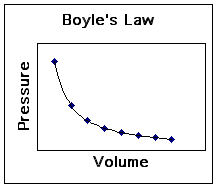
The discovery of the relationship between gas volume and air pressure was published by Robert Boyle in 1662 and is known today as Boyle’s Law.  It states that air pressure is inversely proportional to the volume it occupies, for a fixed temperature in a closed system. 

The Pressure-Volume Correlation
Boyle's Law
Graph of Boyle’s Law

In early human history an understanding of the universe was mostly marked by deep philosophical thinking. Questions were poised and then mulled over. The answers were logical explanations that came directly from the human mind. Little emphasis was placed on observation and experimentation. Starting around the 16th century the field of science was beginning to make radical changes. It marked a period of revolution in a way of thinking and a desire to know and understand natural laws. The new way of thinking affected all aspects of society, influencing and altering belief systems, politics, and the economy. One critical advancement in the way science was conducted was that the mathematization of science was beginning to appear and take hold. Boyle’s Law was the first physical law to be expressed in the form of an equation describing the dependence of two variable quantities.

The foundations of Boyle’s Law was laid on experiments with air pressure and connected with the work of Itialian physicist Evangelista Torricelli and the French mathematician Blaise Pascal. Torricelli’s work on the vacuum began to break down the deeply held Aristotelian notions about the weight and nature of air. Further experiments at this time were conducted that illustrated the compression and expansion abilities of air. Pascal, having learned of Torricelli’s experiments, also began experimenting on the nature of air. He noted that when a half inflated balloon was carried up a mountain (to an place of different air pressure) the balloon would expand. He therefore speculated that there was a relationship between the volume of air and the pressure exerted on it.
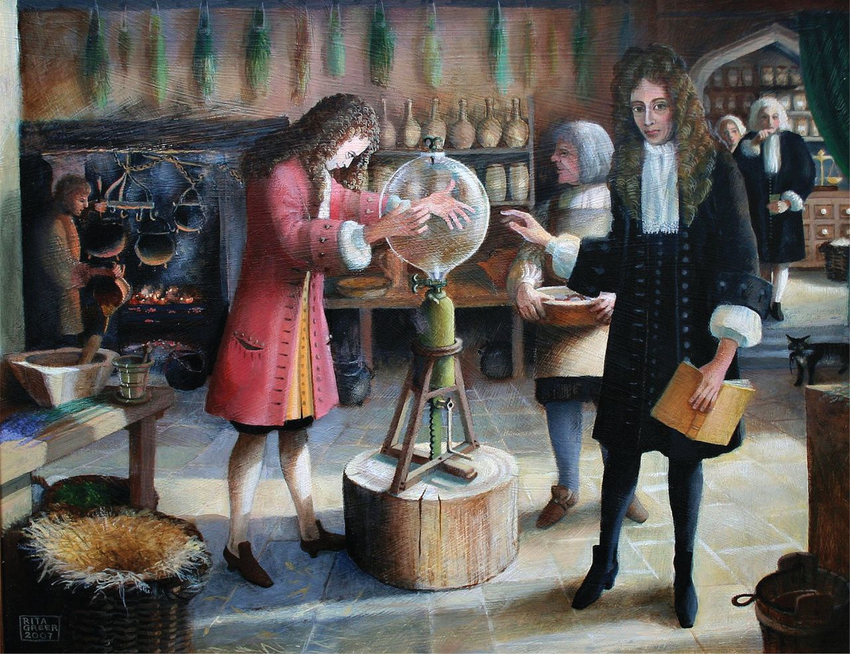
Robert Boyle and Robert Hooke experimenting with an air pump
(Credit: Wikimedia Commons)

The original hypothesis was given to Boyle by Richard Towneley and his assistant Henry Power in 1661 via letter. Power performed his first experiments on air pressure in 1653. He performed more conclusive ones in 1660 with the collaboration of Richard Towneley. These experiments were similar in nature to the Torricellian experiments that were commonly being performed at the time. Boyle was also familiar with the Torricellian experiments when he began systematically investigating air pressure in 1658. He was working with Robert Hooke, who was designing a superior air pump that they were using to investigate the elasticity of air. In 1661 Towneley and Power deduced that there was a proportionality with the volume of air and the external air pressure in their experiments. Boyle devised a series of experiments to check the hypothesis. He repeated several experiments using different amounts of mercury in a J-tube, an apparatus for measuring both the volume of air and its pressure. Publication followed after Boyle and Hooke had successfully verified the Towneley/Power hypothesis.  In 1676 the French chemist Edme Mariotte also came to the same conclusion independently but in addition discovered that air volume changes with temperature.

Boyle’s law can be expressed mathematically as P\propto {\frac {1}{V}} where P is the pressure of the gas and V is the volume of the gas. In simple terms it means that if volume decreases then pressure increases, and vice versa. Boyle’s Law is an equivalency law which can also be expressed as P1V1=P2V2 where P is the pressure of the gas and V is the volume of the gas.

Applications of Boyle’s Law

Practical applications of Boyle’s Law can be applied to nearly anything that involves compressed air to do useful work. One common contemporary example is the aerosol spray. Aerosol spray works by having its contents contained in a can under extremely high pressure. When the nozzle is pressed down the pressure of the gas or liquid inside the can is decreased. As a result the compressed gas expands causing its contents to spray outward. This is how hairspray, spray paint, and every other aerosol spray works. Boyle’s Law can also be applied under varying temperatures. A basketball bounces less and your car tires air pressure decreases as it becomes colder outside.

However the most vital example of Boyle’s Law at work is in the human respiratory system. You bring air into your lungs by contracting your respiratory muscles to increase the volume in your chest, and hence decreasing the pressure on your chest. Basically air moves from your lungs to the atmosphere and back due to a change of pressure inside and outside of your chest. The mechanics of breathing are nicely explained by this scientific principle!

Continue reading more about the exciting history of science!
Robert Boyle

Robert Boyle portrait
Robert Boyle

The scientific contributions of Robert Boyle (1627 – 1691) cover  a variety of subjects including physics, hydrostatics, and the earth sciences, however he is best known for his contributions to the field of chemistry.  Through his efforts, his work helped to break away the scientific world from alchemy and to usher in modern chemistry.

Born in Ireland to a wealthy family, Boyle attended a private boarding school at the age of eight, followed by a tour of the European continent with his French tutor that ended in Italy at the time when the great Galileo died.  This experience had a profound impact on Boyle and when he returned to England where he hooked up with other like-minded individuals to form the “invisible college” where they met, often at Gresham College, and  was to be the precursor of the Royal Society of London.

At the same time Boyle hired Robert Hooke as his assistant.  The two like-minded men collaborated on many discoveries including Boyle’s Law, which states that pressure and volume of gas have an inverse relationship at a fixed temperature.

The publication of The Sceptical Chymist in 1661 which is considered by many as the beginning of modern chemistry.  The book is composed as a dialogue and in it he rejects the ideas of Aristotelian elements of earth, fire, wind, and water and suggests the idea that matter consists of atoms in motion and that every phenomenon is the result of the collisions of these particles.

1643: Discovery of the Vacuum

The existence of a vacuum, a space completely empty of matter, had been debated since at least the ancient Greek philosophers, and probably much longer.  In 1643 the Italian physicist Evangelista Torricelli showed that for all practical purposes a vacuum was indeed possible. 

Philosophical Ideas about a Vacuum

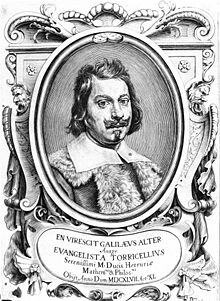
Portrait of Evangelista Torricelli
Evangelista Torricelli

The philosophical debate about the existence of a vacuum, or the void as the Greeks may have called it, has been around for centuries. Is there a void or is no void possible? The debate itself was contentious and much doubt surrounded the idea that a vacuum could actually exist. In ancient Greece the idea began with Democritus, born around 460 BCE, who expanded on and synthesized the work of his teacher Leucippus. Democritus proposed that the world was composed of tiny particles moving around in an infinite void which he called atoms. Thus the space in between these particles was empty space, or what we might today call a vacuum. The most influential Greek thinker, Aristotle, made arguments against these ideas in his book titled Physics. The phrase “horror vacui” (nature abhors a vacuum) is attributed to Aristotle.

Given what we know of the influence of Aristotle over Medieval thinking it is no surprise that the idea of a vacuum fell out of favor during Medieval times. The rejection of a vacuum was restated time and again up until the time of Galileo Galalei.

An Accidental Discovery

Evangelista Torricelli was born in Faenza, Italy in 1608 to a relatively poor family. His father was a textile worker but he had to good sense to realize the extraordinary intellectual talents and abilities of his oldest child. Lacking the resources to provide his son with a proper education he send him to his Jesuit uncle where he was to receive his education at the Jesuit College in Faenza, then later in Rome where he studied science under the Benedictine monk Beneditto Castelli. Castelli was a student of Galileo, a figure who inspired Torricelli’s in his mathematical and scientific career included his experimental verification of a vacuum.

Late in his life, Galileo became preoccupied with the observation that well diggers suction pumps could only raise water about ten meters. In 1640 Galileo, along with his two assistants Torricelli and Giovanni Baliani, conducted a suction pump experiment at a public well. In every instance, no matter what they tried, the water would not rise more than 9.7 meters about the level of the well water. Galileo incorrectly surmised that a force created by a vacuum was preventing the water from rising any higher.

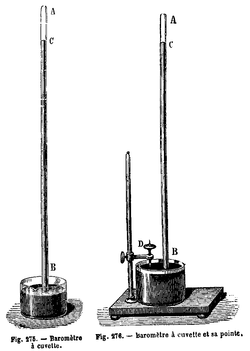
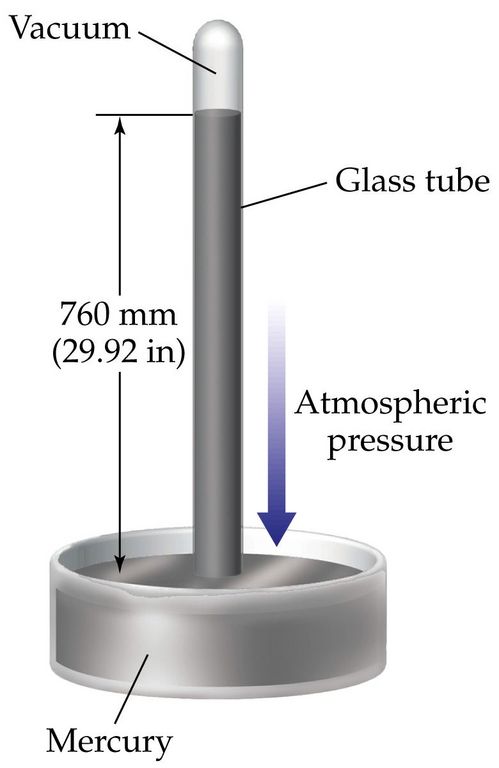
Torricelli discovered the vacuum accidentally when he was conducting experiments that were designed to solve the problem of pumping water out of a deep well.  He tried to scale down the problem using mercury instead of water because liquid mercury is much more dense than water and he hoped to be able to observe the same phenomenon at a lower height.  He took a tube closed at one end and filled it with mercury.  He stuck the open end in a bowl of mercury and slowly raised the closed end, where eventually a gap appeared above the mercury.  The gap could not have been air because when he lowered the tube again the gap vanished immediately, quicker than air could have dissipated. The gap above the mercury was the first experimentally verified vacuum.

As to the problem of rising water and mercury above a certain level, Torricelli proposed the correct answer. It is that the mercury was rising due to the atmospheres weight (or atmospheric pressure) pressing down on the mercury in the dish. He correctly predicted that height of the mercury column would vary from day to day as the atmospheric pressure also changed. In effect, he invented the apparatus known today as the barometer.

Modern Uses of Vacuum Technology

The discovery of the vacuum was eventually applied to advances in technology and its principle many different industries today. One of the most common uses is in the food industry, where vacuum technology is used in the transport, processing, and packaging of food, and in bottling of beer and soft drinks. It prolongs the shelf life of food and maintains its nutritional content. Vacuum technology is used in the chemical industry to treat and purify reactants and products. Other applications of vacuum technology include usage in heating and cooling systems, light bulbs, steam engines, and cathode ray tubes.

Continue reading more about the exciting history of science!
1590s: The Microscope

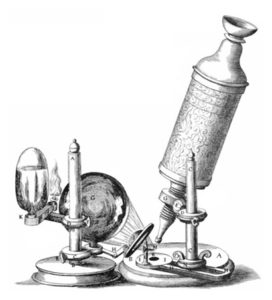
An Early Microscope
An Early, Crude Microscope

The vast scale of the universe, both cosmic and microscope, is one of the marvels that modern science has revealed. The revelation is the result of the invention of two instruments, the telescope for revealing the cosmic and the microscope for revealing the microscopic. Each of these instruments were invented roughly 500 years ago. Each changed how we thought about our place in the universe.

It is extremely difficult to imagine things on a microscopic scale given the limitations of our human senses. But we can try. Let’s take one example to illustrate the miraculous world of the microscopic. In a single drop of seawater one can find tens of millions of viruses and bacteria. Yet these microorganisms are completely invisible to the naked eye. The invention of the microscope was the instrument that shined a light on the realm of the small.

The Invention of the Microscope

Like many pre-modern inventions, the exact date of the first microscope is disputed, murky, and confused. However it is still possible to shine a light on this inventions beginnings. Credit is most commonly given to Zacharias Janssen and his father Hans Martenz for creating the first microscope as early as 1590, or at least sometime during that decade. 

They were, of course, not the first people to have experimented with enlarging objects. Centuries earlier saw lots of people attempting to magnify objects by means of using water to bend light or by using a very simple lens. However it’s probably safe to say that these methods do not meet the qualifications to what most would consider a microscope.

The important point was the people in the ancient world did come to learn that the best way to magnify an object was by viewing it through a lens. The important breakthrough occurred when several lenses were placed in a tube resulting in significant magnification of objects when viewed through a single lens. By using several lens to magnify an object, the compound microscope had just been invented.

An Improved Microscope

Early microscopes came in a variety of forms ranging from single yet sophisticated powerful lens such as the type that Antony van Leeuwenhoek created and used, to simple compound microscopes such as those created and used by Zacharias Janssen, Galileo Galilei, and Robert Hooke.ย  The term microscope was first used in 1625 to describe one of Galilelo’s instruments that he invented in 1609. Although these microscopes provided increased magnification there were persistent problems with the image quality. The major nagging image issue was called chromatic aberration. It is caused by light passing through the lens at different points and color wavelengths, resulting in a color distortions at the edge of the image. This problem persisted early on due to the relative low quality of glass used combined with flaws in design of the microscopes.

It took about 100 years for significant discoveries to be made with the microscope. This is due to early microscopes having low magnifying power and producing blurry images. The first big breakthrough came with the publication of Robert Hooke’s book Micrographia in 1665. The book dazzled the imagination of the people who read it and naturally sparked an enormous amount of new interest in the emerging field of microscopy. Antony van Leeuwenhoek, a contemporary of Robert Hooke, made some of the most powerful microscopes of the early era. Throughout his life van Leeuwenhoek made over 500 microscopes, which were extremely powerful single lenses as opposed to the compound microscopes that Robert Hooke used.

Modern Microscopes

Today microscopes are available in an even greater variety of forms. By the turn of the 20th century the resolution limit of light microscopes had been reached. This limitation was quickly overcame in 1904 when a UV microscope was invented that had double to resolution of a light microscope. Since that time various types of more powerful microscopes have come onto the scene. One of the most powerful is the electron microscope. First invented in the 1930s, electron microscopes employ beams of electrons rather than light (since the wavelength of electrons is up to 100,000 times shorter than that of light), allowing for significantly greater magnification.

Today’s most powerful electron microscopes allow researchers to see resolutions so clearly that they can view images of individual atoms. Viruses can be viewed at a scale of less than four angstroms, or four ten-billionth of a meter. Resolution of this magnitude provides a powerful tool in advancing the field of microbiology.

Continue reading more about the exciting history of science!
Antony Van Leeuvenhoek

Antony Van Leeuvenhoek portrait
Antony Van Leeuvenhoek

Important advances in microbiology were made by Antony van Leeuvenhoek (1632 – 1723), which include a substantial improvement on the microscope followed by the discovery of a variety of single celled organisms.

Antony Van Leeuvenhoek was for his time an unusual candidate to make breakthrough scientific discoveries.  He earned no university degrees and therefore had no formal scientific training, and he was not particularly wealthy.  His trade was that of a textile merchant that led him to develop improved lens in order to better observe thread quality.  He cultivated in himself a tremendous skill in lens making with some of his lens being able to magnify up to 300 times and possibly higher, which was a significantly higher level of magnification than the compound microscopes of his day that only magnified around 20x – 30x.  During his lifetime he may have made over 500 magnifying lenses.

He used these lenses, along with his terrific eyesight and observational skills, to observe the first bacteria.  Through a friend he communicated with the Royal Society through dozens of informal letters, and although the Society was originally skeptical of his claims they were later verified by Robert Hooke and others. This led to his election into the Royal Society in 1680 and bestowed on him a tremendous amount of fame.

1665: The Cell

The observation by Robert Hooke in 1665 of what became coined the cell provided the starting point for a sequence of discoveries at the microscopic level. A rapid pace of discoveries quickly followed and has continued into our present time. From this moment onward our view of life has been revolutionized.  But while it was Hooke who observed the cell by viewing thin layers of cork, it was Antony Van Leeuwenhoek who can be considered as the first microbiologist and dramatically expended our view of cellular life. 

The Discovery of the Cell

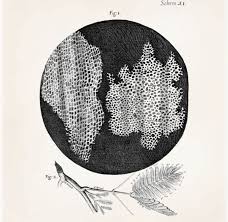
Rendering of a Cork Cell as seen by Robert Hooke; Micrographia, 1665
Rendering of a Cork Cell as seen by Robert Hooke
(Credit: Micrographia, 1665)

The invention of the microscope in the last 16th century allowed for the discovery of the cell. Microscopes had been around for about a generation or so before Hooke began making and using his own instruments. By this time microscopes were very rudimentary, but Hooke’s had a technical supremacy in that it could magnify by up to 40x to 50x making it the best of its time. In 1663 and the following year Hook began making his microscopic observations. In 1665 he published his work in a book titled Micrographia. It was the first major publication of the Royal Society.

Meanwhile in Antony Van Leeuwenhoek was living in the Dutch Republic working as a textile worker. He was not a formally trained scientist at the time and was largely a self-taught man. He came across Micrographia and was fascinated by what he read and saw in it. He was already proficient in lens making and in the 1670s he started observing microbial world. He developed terrifically powerful microscope – ones that could magnify up to 270x. To the dismay of many was highly secretive about his techniques. Over the course of Van Leeuwenhoek ‘s career he made almost 200 reports to the Royal Society – offering facts of his findings including drawings. Leeuwenhoek began his work by analyzing drops of pond water. He also went to work on replicating some of Hooke’s earlier observations. In 1676 he to some of this tooth plaque and saw there were thousands of what he called living animalcules because they were moving like little animals. He had discovered bacteria.

A Wondrous Biological Factory

Contained in the cell are the structural and functional operations of a living organism, making it the basic building block of life.  All cells follow a similar basic plan. The cell membrane is the outer most layer of the cell and is composed of a mixture of lipids and proteins.  Inside the cell is whats called the cytoplasm, which is a complex mixture of water, salts, enzymes, and other organic molecules or organelles. The cytoplasm includes the cell nucleus which contains the cells genetic material.

The inside of a cell is a busy place.  That activity that happens there can be mind boggling. A cell is made up of millions of objects performing a multitude of tasks.  Millions of chemical reactions are taking place inside each cell.  Enzymes, which are a specific type of protein, perform up to a thousand tasks per second.  Some proteins exist for a short of thirty minutes, others for up to weeks.  Each cell contains up to 20,000 different proteins.  These proteins can be made up of up to 50,000 molecules.  This means each cell can be made up of hundreds of millions of chemical molecules, a staggering amount of chemical activity. 

Most of the food we eat and oxygen we breath are taken to the mitochondria, where it is converted into a form of energy called ATP.  A typical cell in each human body will contain about a billion ATP molecules.  In a matter of minutes all of these molecules will be used up, and another billion will have replaced them.  Each day every person produces about half of their weight in ATP.  This weight mostly comes from the air that we breath. 

From Cell Discovery to Cell Theory

The discovery of the cell lead to the elucidation of a core theory in biology called cell theory, which roughly states that all living organisms are made from basic units called cells that continually reproduce. It would take another 150 years after the discovery of the cell for cell theory to become established.

Critical work in advancing cell theory began in the early 19th century. In 1838 Matthias Jakob Schleiden was working with plants and concluded that all plants are made up as cells. This influenced the German physiologist Theodor Schwann and the next year he published Microscopical Researches into the Accordance in the Structure and Growth of Animals and Plants, a landmark work where he proposed his own Cell Theory.

Continue reading more about the exciting history of science!
Robert Hooke

Robert Hooke portrait
Robert Hooke

Seventeenth century England underwent sweeping changes in all aspects of human civilization and Robert Hooke (1635 – 1703) helped to provide a catalyst in ushering humanity into the modern scientific era.  Among his greatest accomplishments include discovering the building blocks of life and coining the word cell; discovering, along with Robert Boyle, many important aspects of air; being one of the first to observe fossils and provide a reasonably accurate description of how fossils form; and discovering laws of elasticity for which Hooke’s Law is named after him.

Robert Hooke live through a period of remarkable change in England which included the English Civil War which resulted in the trial and execution of Charles I, the Protectorate under Cromwell followed by the restoration of the monarchy, the Great Fire of London, and the Glorious Revolution.  With all this social and political upheaval it opened the way for new modes of thoughts and institutions.  One important new institution to the progress of science was the Royal Society of London, founded in 1660, of which Hooke has early involvement with and becomes an elected Fellow in 1663.

drawing of an ant from Micrographia by Robert Hooke

It was shortly after that time, in 1665, where Hooke released the first major publication by the Royal Society, a book titled Micrographia.  In it he revealed his observations as seen through the microscope while littering the pages with illustrations of the microscopic world.  His work proceeded to spark a huge interest in microscopy. 

Along with his scientific achievements Hook played a key role in rebuilding London after the fire in 1666.  His architectural designs earned him significantly more wealth than he earned as a scientist allowing him to die a wealthy man dispute him coming from a modest background.

William Harvey

William Harvey portrait
William Harvey

The English physician William Harvey (1578 – 1657) earns the accolade of being the first person to describe the circulatory system, largely laid out in his 1628 book On the Motion of the Heart and Blood.  Harvey made his discoveries by largely ignoring the medical texts of his time, notable those of Galen, and instead by performing experiments and making dissections on animals.  Sadly, animals were probably harmed in the making of his discoveries.

Like most prominent scientists of his time, Harvey was born into a wealthy family and attended university at Padua in Italy.  Years later, he served as physician to King James I and Charles I, becoming a committed royalist in the process while building up a considerable medical practice.

Harvey lived in a period where most lives were still governed by superstition and witchcraft was still feared.  Being a learned man with an extensive medical background he was skeptical of these claims, as most learned people are and should be.   He and ended up examining several accused witches and played a key role in the acquittal all of the accused witches he examined.

1628: Blood Circulation

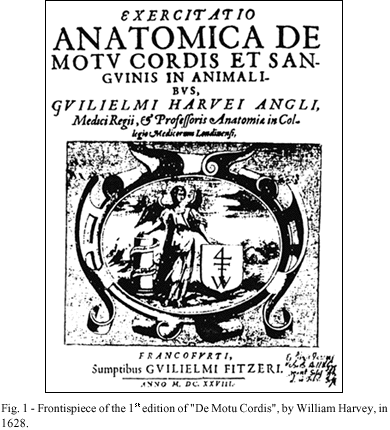
After thirty years of research, William Harvey’s landmark book On the Motion of the Heart and Blood in Animals established once and for all that blood flow was entirely circular and that the heart was a pump.  The discovery of blood circulation was transitory for a few important reasons. It established the principle of experimentation in medicine. It helped to create the new field of physiology. Lastly, it marked the beginning of the true understanding of our circulatory system with additional details to emerge later on.  

A Brief History of the Cardiovascular System up to Harvey

On the Motion of the Heart and Blood in Animals
(Credit: Wikimedia Commons)

The ancient Greeks, those pioneers of scientific discoveries, once again lead the way in the fields of medicine and physiology in antiquity. It was understood by the Geeks that the peripheral parts of the body required nourishment. The mystery was how this was accomplished. The first detailed attempt at this explanation (that rejected divine causes) was put forth by Hippocrates of Cos and his pupils. It was grounded in humorism, a doctrine declaring that health was maintained by a balance in humors (bodily liquids). Disease was caused by an imbalance in these humors. Various Greek thinkers, including Praxagoras, Erasistratus, and Aristotle, identified the heart, veins, and arteries and theorized about their role in the blood system.

The next notable advancements came from Galen. Born during the second century AD at the height of the Roman Empire, he built on the systems he inherited from the Greeks while adding new information along the way. He carried out many experiments on animals, however none on humans. He was accumulated an array of facts and inherited ideas from which he attempted to deduce how the entire system worked. He differentiated between arteries and veins and proved that they both contain blood. This differed from Erasistratus’ view that arteries only contained air. He noted that the heart pulsated, that everything breathes, and made connections between the liver, heart, and lungs. While his system was complicated it was nowhere near as complicated as the human body’s system actually is. It can be summarized as the liver, veins, and the right side of the heart were to deliver nourishment to the peripheral parts of the body. Blood was thought to be manufactured in the liver, traveled to the peripheral parts of the body through the veins where the tissues take up its nourishment. The lungs, arteries, and the left side of the heart were to deliver fresh air and to cool the body.

The middle ages in Europe provided little advancement in knowledge. During this time the Catholic Church rose to power and suppressed any idea’s conflicting with Christian doctrine. Experimentation was discouraged and any new discoveries, such as Andreas Vesalius’s dissections or Realdo Colombo’s of pulmonary circuit, were made to fit in with Galen’s previously existing ideas, or ignored. This void of progress lasted about a thousand years, up to the time of the Renaissance.

William Harvey’s Contributions

The man who finally solved the riddle of the pathway of blood in the body was William Harvey. Born in 1578 during the Scientific Revolution, Harvey attended the University of Padua, the greatest medical school of its time. There he learned Galen’s physiology and throughout his life he still held on to some notions of ancient doctrine. However like many of the famous early scientists of his era he was not afraid to challenge it. He was very interested in academics and in his late 30s he decided to tackle the problem of how the heart works.

First, Harvey worked with animals to make his observations, sometimes cutting the chest of the animal open to watch what happens to the heart as the animal dies. Through his dissections, he was able to identify a thrusting motion which we now call systole, where the blood is moved out through the body. More specifically, he noticed that blood returns to the heart and fills up the atrium, the two chambers above the heart. When the atrium becomes full, the blood empties into the ventricles below, which then pump the blood out to the lungs and rest of the body. These studies become to topic of his lectures as the Lumleian Lecturer at the Royal College of Physician’s, and became the raw material for the first seven chapters of his later book On the Motion of the Heart and Blood in Animals. Additionally, his experiments with animals showed that that blood flows away from the heart in arteries and towards the heart in veins.

It had also made little sense to Harvey that so much blood should be going out to nourish the body with so little of it returning. Was it really possible that the liver could really make so much blood? He decided to make some rough estimates of the volume of blood passing through the heart. First, he noted that a human heart could hold about two ounces of water. He multiplied that by an average number of beats per minute, and took that figure times sixty for each minute in an hour. This lead to a conservative estimation showing that about at least hundreds of pounds of blood must flow through the heart in an hour. Clearly there was no way the body could produce this amount of blood each day.  By simple deduction this proved that blood flow must be circular.  The question became how did the blood come back?

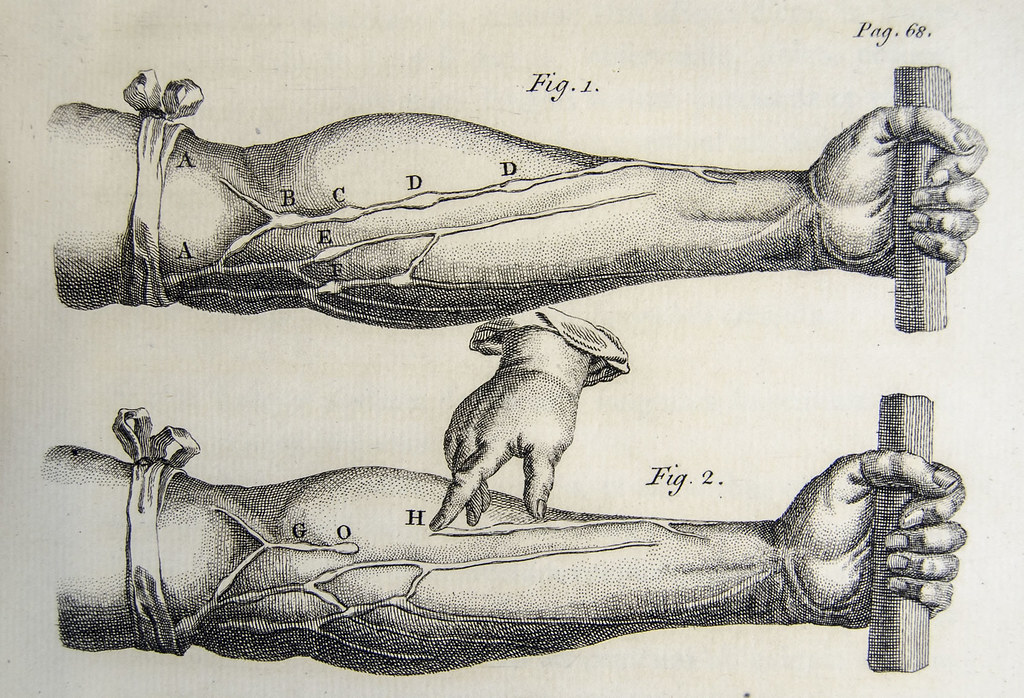
Veins of the Arm,  On the Motion of the Heart and Blood in Animals
Veins of the Arm, On the Motion of the Heart and Blood in Animals
(Credit: Creative Commons)

His teacher at the University of Padua was a man named Fabricius who discovered the values in the veins but could not explain their function. By compressing veins at various places of the body, Harvey showed that blood flows from the periphery to the center of the body and that blood flows in one direction. The valves keep the blood from reversing direction.

Although Harvey proved blood circulation, he work had little immediate effect. Blood letting continued for some time and the clinical value of understanding blood circulation seems of little importance. In the long run, it marked the end of the Galenic theory and marked an important turning point for modern medicine.

Continue reading more about the exciting history of science!
John Napier

John Napier portrait
John Napier

John Napier (1550 – 1617) was a Scottish mathematician best known for his formulation of logarithms which provided aid to mathematical calculations.  In 1614 he published he book titled A Description of the Wonderful Law of Logarithms, which explained the technique of devising the logarithm (and differs from today’s concept of having a base raised to a corresponding exponent) and provided copious tables of logarithms to make calculations easier.  Additionally, Napier was the first to popularize the decimal point as a means to separate the fraction from the integer.

The logarithm is simply the inverse operation the the exponential, in other words a logarithm can be used to undo what an exponent does.  Logarithms were particularly useful in long distance navigation and astronomy whose calculations involved trigonometric functions.

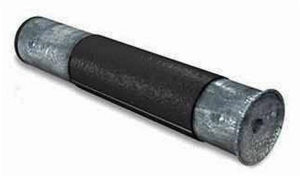
In addition to publishing his impressive tables of logarithmic calculations Napier also found other ways to make mathematical calculations easier.  He invented what is called the Napier bones, a manually-operated calculating devise used to calculate products and quotients.