1796: The First Vaccination

Humanity has achieved countless medical breakthroughs over the centuries, yet few have had as profound and lasting impact as the invention of the first vaccine.  A vaccination is the process of administering biological preparation called a vaccine to stimulate the immune system and protect individuals from infectious diseases.  The primary purpose of the vaccine is to mimic the infection without causing the disease, although sometimes mild symptoms will occur for a brief period of time.  This will prime the immune system to recognize and respond effectively later if the person is exposed to the actual infection.

This remarkable achievement was first performed by the English physician Edward Jenner in 1796.  Despite recent controversies over vaccinations, this medical breakthrough had led to the prevention of many diseases and has undoubtedly saved countless lives.  

Edward Jenner and the Smallpox Threat

This first vaccination was developed against smallpox, a disease that had plagued humanity for thousands of years.  This highly contagious and often fatal disease caused high fever, severe skin rashes, and the formation of fluid-like blisters on the skin.  Smallpox had a mortality rate of up to 30%.  Outbreaks were common, leading to the loss of millions of lives.  Edward Jenner, an English physician and scientists, made his revolutionary discovery late in the 18th century when he developed a vaccine for smallpox.
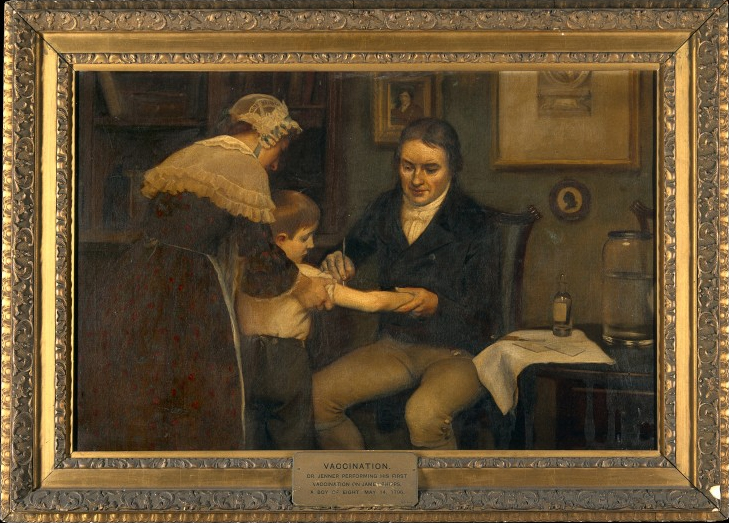
Edward Jenner Vaccination
Edward Jenner Administering the First Vaccination

Earlier in the 18th century it was observed that people who suffered from a more benign form of cowpox became immune to smallpox.  Jenner had also observed that milkmaids who had contracted and subsequently recovered from cowpox did not appear to contract smallpox.  These observations led Jenner to hypothesize that the cowpox infections somehow helped to protect these people against smallpox.  In 1796 Jenner tested his hypothesis.  He took cowpox material from Sarah Nelmes, a milkmaid, and injected it into the arm of an eight year old boy, James Phipps.  The boy became sick for a few days but soon recovered.  Two months later he was exposed to smallpox and showed immunity to the disease, which lasted for the rest of his life.  It was the proof Jenner was needed.  He had successfully developed worlds the first vaccination, the word derived from the Latin word vacca, which means cow.

Two years later Jenner published An Inquiry into the Causes and Effects of the Variolae Vacciniae, which outlined Phipps vaccination as well as twenty two related cases.  Jenner’s publication soon generated much interest on the topic after subsequent vaccinations were reproduced by others.  His work laid the foundation for the science of immunology, leading the development of vaccines for many other diseases.  Over the coming decades advancements in microbiology and immunology led to the development of vaccines for several diseases, including polio, influenza, measles, mumps, rubella, HPV, and many others.  

Most recently the COVID-19 pandemic, caused by the SARS-Cov-2 virus, highlighted the need for vaccines.  In a remarkably short time multiple vaccines were developed and authorized for emergency use to combat the pandemic.  Governments launched vaccination campaigns globally to control the spread of the disease and reduce its impact on the public health.  

A Long-Lasting Global Impact

Jenner’s discovery of the vaccination was nothing short of revolutionary. Within a few years vaccinations spread around the world and were being endorsed by governments. As early as 1801 Russia supported the use of vaccinations and in 1802 Massachusetts became the first state to actively support their use as well. Today vaccinations provide a variety of public health benefits.  These benefits include:

  1. Disease Prevention:  The primary purpose of vaccines is disease prevention.  They work by stimulating the immune system to recognize and fight specific pathogens, reducing the likelihood of infection.
  2. Reduced Morbidity and Mortality:  Vaccines reduce the incidence of diseases, hospitalizations, and deaths.  Additionally, after a large enough portion of the population is vaccinated, herd immunity is achieved, protecting even those who have not been vaccinated.
  3. Elimination of Diseases: Vaccinations have played a paramount role in the elimination or near elimination of many diseases, beginning with smallpox.  In 1980, the world was officially declared free from this deadly disease.  Polio is another disease on the verge of elimination.  
  4. Various Economic Benefits:  By preventing illnesses, vaccines reduce healthcare costs associated with treating infectious diseases.  They also minimize lost productivity due to illness in the workplace.
  5. Prevention of Outbreaks:  Vaccines are critical in preventing outbreaks of infectious diseases.  

It is because of these and numerous other benefits that vaccines are considered one of the most successful and cost-effective public health measures.

Continue reading more about the exciting history of science!
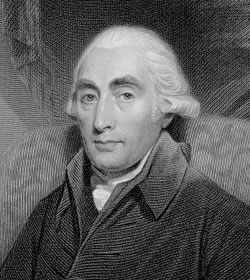
Joseph Black

Joseph Black portrait
Joseph Black

Joseph Black (1728 – 1729) is considered the father of quantitative chemistry and his research on boiling and freezing liquids revolutionized our understanding of heat.  He is best known for his discoveries of carbon dioxide and latent heat.

Born in Bordeaux into a large family of Scottish wine traders, Black was educated at the University of Glasgow where he studied medicine quickly took a liking to chemistry after attending the chemistry lectures of William Cullen.  In 1752 Black transferred to the University of Edinburgh to finish his medical studies.  His medical thesis turned out to be one of the most important scientific papers in the history of chemistry.  It centered what happened when a from of magnesium carbonate was heated.  He ended up isolating the gas given off, carbon dioxide, but the real importance in his paper was that it was the first instance where anyone was taking careful, precise measurements in chemistry.  This paper and his follow up lectures on it laid the basis laid the foundation for quantitative chemistry.

After obtaining a professorship at Glasgow, Black took up research on the nature of heat.  By exploring phenomenon that there is no temperature change in a phase change, such as solid to liquid or a liquid to a gas, he came up with the notion of latent heat.  Latent heat is then the thermal energy released or absorbed by a substance during its phase change. Heat water at 100 degrees Fahrenheit and its temperature will continually increase until the boiling point of 212 degrees Fahrenheit.  Continue adding heat the the water and its temperature will stay at 212 degrees, while some it evaporates as gas.  This is because all the energy added to the boiling water is being absorbed as latent heat of vaporization.  When James Watt began working at Glasgow University the two became friends and Black shared his ideas on latent heat, which Watt surely used to improve his steam engines powered the industrial revolution.

Black eventually succeeded William Cullen as Professor of Medicine and Chemistry at the University of Edinburgh where he was a superb lecturer.  For thirty years held this position until his failing health forced him to retire.

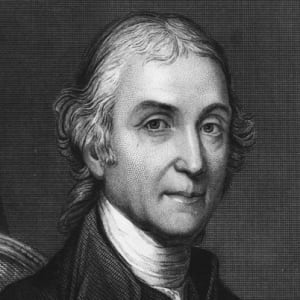
Joseph Priestley

Joseph Priestley portrait
Joseph Priestley

Joseph Priestley (1733 – 1804) is usually credited with the discovery of oxygen, which helped to overthrow the phlogiston theory that attempted to explain oxidation processes.

Priestly was born in Bristal Fieldhead, England into a family with a strong religious influence.  Throughout his life he had no formal scientific training but his interest in science was aroused when he met Benjamin Franklin in London in 1766 and had discussions with him about electricity.  He took to the subject quickly and the next year published a 700 page work, The History and Present State of Electricity, which went through five successful editions.

The work for which Priestley is most famous for was done in 1774.  He would use a lens to focus sun rays to heat various chemicals and observe what gases they would emit.  When he focused the sun rays on mercuric oxide he was able to capture the gas emitted.  He tested this new gas on mice and noticed they would live much longer entrapped with this gas than with an equal amount of air.  The gas was not soluble in water and candles burned much longer in it too.  He had discovered oxygen.  This work combined with that of Antoine Lavoisier’s further experiments helped to overthrow the theory of phlogiston.

Although Priestly was raised as a devoted Calvinist he came to reject those beliefs and increasing came to hold unpopular religious beliefs.  In the last decade of his life he fled England to the United States where he lived his final days in a more tolerant religious environment.

1897: Electron

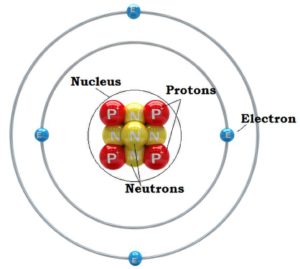
An atom showing its protons, neutrons, and electrons.
Nuclear Structure of the Atom

The atomic theory of the atom was proposed by John Dalton in the early 19th century. Dalton claimed that all atoms of the same element are identical, but that atoms of different elements vary in size and in mass. His theory suggested that atoms were indivisible particles, making them the smallest building blocks of matter. However by the middle of the 19th century, a growing body of experiment evidence began to challenge this notion. As the century drew to a close some scientists that speculated that atoms may be composed of additional fundamental units, and by the late 19th century convincing evidence began to emerge from experimental research to support this hypothesis.   The discovery of the electron was the first of a series of discovery’s, spanning a few decades, that identified the major subatomic particles of the atom.

J. J. Thompson’s Experiments

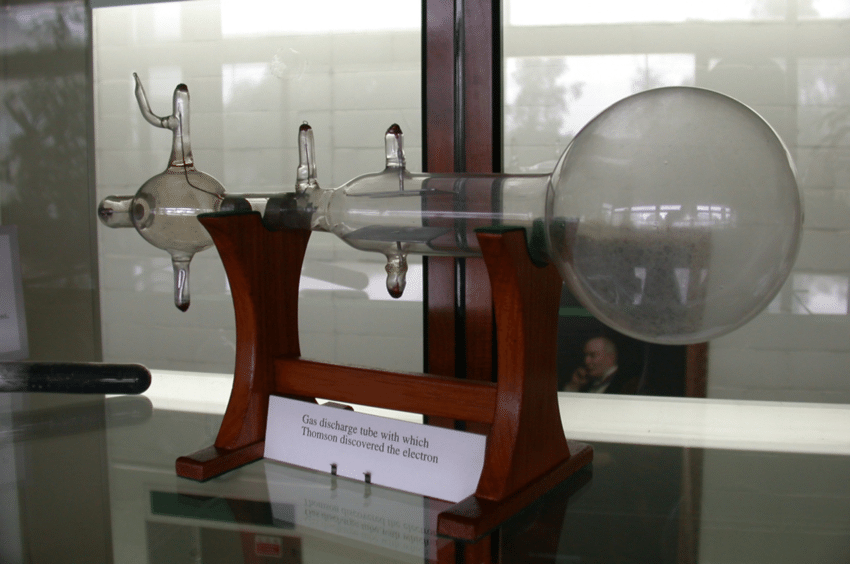
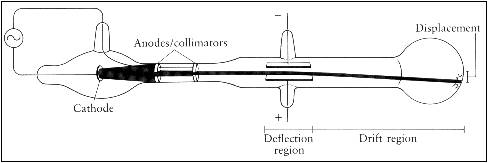
This experimental evidence came during the years 1894-1899 when J. J. Thomson conducted research with cathode ray tubes, the same technology that also played a critical role in the discovery of X-rays and on work which led to the discovery of radioactivity.  Cathode rays are the currents of electricity observed inside a high vacuum tube.  When two electrodes are connected to each end of the tube and voltage is supplied, a beam of particles flows from the negatively charged electrode (the cathode) the positively charged electrode (the anode).  In a lecture to the Royal Institution on April 30, 1897, J. J. Thomson suggested that these beams of particles were smaller, more fundamental units of the atom.  He termed them ‘corpuscles’ but the name never stuck, and they were eventually given name we are familiar with today: electrons. 

J. J. Thomson's cathode ray tube used to discover the electron
J. J. Thomson’s cathode ray tube used to discover the electron
(Credit: Donald Gillies)

J.J. Thomson performed several experiments whose conclusions supported his hypothesis.  Firstly, in 1894 Thomson established that cathode rays were not a form of electromagnetic radiation, the assumption at that time, by showing that they much move slower than the speed of light. Soon after he conducted experiments deflecting the rays from negatively charged electric plates to positively charged plates where he was able to show that the beams were streams of negatively charged particles.  In another experiment he used magnets to deflect the beams which allowed him to determine their mass-to-charge ration.  He approximated their mass at 1/2000th of a hydrogen atom indicating that they must be only a part of an atom.  This is an incredibly small mass and is the smallest measured mass of any particle that has mass.  Lastly, he showed that these particles are present in different types of atoms.

Diagram of a cathode ray tube

The revelation that atoms are made of smaller constituent units revolutionized how scientists viewed the atom world and spurred research on nuclear particles.  Soon after the atomic nucleus was discovered, and the field of nuclear physics was born.  Thomson went on to create one of the first models of the atom, which was called the plum pudding model.  He knew that atoms had an overall neutral charge.  Therefore, his model depicted the negatively charged electrons floating in a “soup” of positively charged protons.  It was a good first attempt at designing a model of the atom but was soon discarded for Ernest Rutherford’s nuclear model of the atom based on the results of his gold foil experiment.  

Impact and Legacy

The discovery of the electron had profound effects on both theoretical and applied science.

The discovery of the electron helped to usher in the era of atomic physics and help to give birth to the completely new and foreign field of quantum mechanics.   Both of these fields are closely related and describe the behavior of particles at the atomic and subatomic level.  Both fields rely on an understanding of atomic structure, of which electrons are a key component.

The discovery of the electron also had a fundamental impact on applied science as it laid the foundation for the development of electronics, a technology that would revolutionize our world.  Electrons, being charge carries, are the fundamental working units of electronic components such as capacitors, diodes, resistors, and transistors.  They are used in all of the familiar electronic devices such as televisions, smartphones, and computers and have made possible the digital transformation of our civilization. In addition to electronics, electrons are involved in atomic spectroscopy, which is the study of the interaction between light and matter. By studying energy levels and transitions of electrons, atomic physicists can identify elements, determine their properties, and study their behavior in various conditions. Spectroscopy is the method used by astronomers to determine the temperature, chemical composition, luminosity, and other characteristics of distant stars across the universe.

Continue reading more about the exciting history of science!
Joseph John Thomson

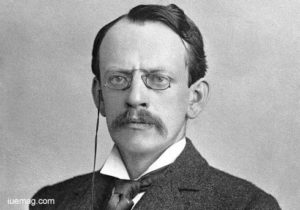
Joseph John Thomson (1856 – 1940) was an English Nobel Laureate who made key contributions to the field of physics.  Most notably he is credited with discovering the electron.

The Life of J. J. Thomson

Joseph John Thomson
J. J. Thomson

J.J. Thomson was born in Cheetham Hill near Manchester in England.  His father planned for him to be an engineer, but when an apprenticeship couldn’t be found he was sent to Owens College at the young age of fourteen.  There he obtained a small scholarship to attend Trinity College, Cambridge where he obtained his Fellowship, received his Master of Arts degree, culminating in the Cavendish Professor of Physics at the University of Cambridge.

While at the University of Cambridge, Thomson did important research to advance our understanding of the atom.  Most important he was one of the first to suggest that the atom may be composed smaller, more fundamental units.  He carried out research with cathode rays, which are beams of light the follow from electrical discharge in a vacuum tube, that led to the discovery of the electron.  From his experiments, he was able to at which these rays were deflected by a magnetic field and to calculate the ration of the electrical charge to the mass of the particles.  What he discovered was that this ratio was always to same no matter what gases were used, and thus he determined that the particles making up the various elemental gases must be the same.

Along with discovering the electron Thomson was the first to determine that each hydrogen atom has only one electron.  He was pivotal in inventing the mass spectrometer which assisted in chemical analyses.  Thomson received various awards for his scientific achievements throughout his life including a Nobel Prize in physics in 1906.  He was knighted in 1908.  JJ Thomson died in 1940 at the age of 83 and was buried in Westminster Abbey with many other scientific greats.

Continue reading more about other impactful scientists!

John Dalton

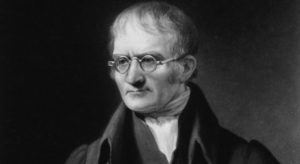
John Dalton portrait
John Dalton

John Dalton (1766 – 1844) was an Englishman born into a relatively poor Quaker family but due to his high intelligence and persistent curiosity he grew to make many important contributions to science in meteorology, chemistry, and physics.  He is remembered most for integrating atomic theory with chemistry.

Dalton embodied the Quaker way of life, living a humble life, never marring and never having any children.  He was content with teaching, lecturing, and doing his research.  In 1794 he wrote his first scientific paper on color blindness, concluding that color blindness was hereditary.  Both he and his brother were color-blind.  Although the specifics of his theory turned out to be incorrect, color blindness was termed Daltonism as a result of his work.

In the early 1800s Dalton formulated his atomic theory, although how he developed his ideas are not fully known.  But he did have a lifelong interest in meteorology and recorded over 200,000 observations in his diary.  He realized that evaporated water was independent or air, that they were each made of discrete particles, and that they mixed and occupied the same space.  Through that he conducted various other experiments on the other known elements of the time – hydrogen, carbon, sulfur, and more – in an attempt to  determine their relative sizes and weights.  He was thus able to formulate a complete atomic theory, although naturally some of his ideas turned out to be incorrect.

Dalton’s atomic theory states that elements are made of vanishingly small, fundamental particles called atoms.  These particles contain the same properties for each element but are different for different elements.  Chemical reactions occur when atoms from different elements are combined or separated.

In 1822 the Royal Society elected him as a member; eleven years later the French Academy of Sciences elected his as a foreign member.  Eleven years after that, in 1844 Dalton died of paralysis.  His ideas lived on laying the framework of atomic theory for future scientists to improve upon and thrust the atomic idea to the forefront of the physical sciences.

1730: The Marine Chronometer

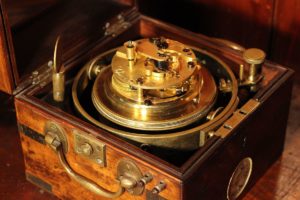
Marine Chronometer
A Marine Chronometer

Amazing that it may seem to people living in the 21st century, finding reliable longitudinal position at sea was not possible until 1730 when John Harrison invented the marine chronometer, a timepiece c

Maritime travel and trade was rapidly expanding in the time leading up to the 18th century.  The discovery of the North and South American continents by European explorers resulted in transoceanic voyages being made for the first time.  This meant a majority of time spent at sea spent out of sight of any landmass, making it trickier to accurately navigate the voyage.

The principle unresolved problem in these transoceanic voyages was finding reliable a longitudinal position while at sea.  This was not possible until 1730 when John Harrison invented the marine chronometer, a timepiece capable of keeping accurate time of a known, fixed location.  

The Longitude Problem

To determine a location one needs to know both the latitude and longitude of the location.  Latitude could easily be measured by using the sun or the stars.  Longitude was more difficult in that it could be calculated by comparing two accurate times – one of a known longitude (a Prime Meridian) and the other at any other location.  A little math works out the rest.  The Earth makes one full rotation per day (360º of longitude) and therefore turns one degree of longitude in 1/360th of a day, or every four minutes.  Work out the time distance from your location to the Prime Meridian, and you know your degree of longitude from the Prime Meridian.

Therefore the trick to determining longitude at sea then required an accurate timekeeping device that had to work on a ship.  However the only known accurate timekeeping devices of the time used a pendulum, which swayed as the boat rocked at sea.

Early methods of measuring longitude proved to be inaccurate, sometimes with deadly consequences.  The most common technique was called dead reckoning.  Beginning with a know starting location, the longitude was simply estimated by the captain based on a number of factors such as current and wind speed, direction of travel, and other factors.  The result was at best a close approximation with compounding errors decreasing the accuracy over time and distance.

A series of naval disasters, most notably a 1707 wreck of four British war ships that saw a loss of over 1500 lives, prompted the British government into action.  The Longitude Act of 1714 provided an incentive to solve this problem by offering a longitude prize ranging from £10,000 to £20,000 to anyone who could provide a simple and practical method to accurately determine a ship’s longitude at sea within one half of a degree.  Four years later the Academie de Paris offered a similar prize.  The race was on to solve the problem. 

John Harrison and the Marine Chronometer

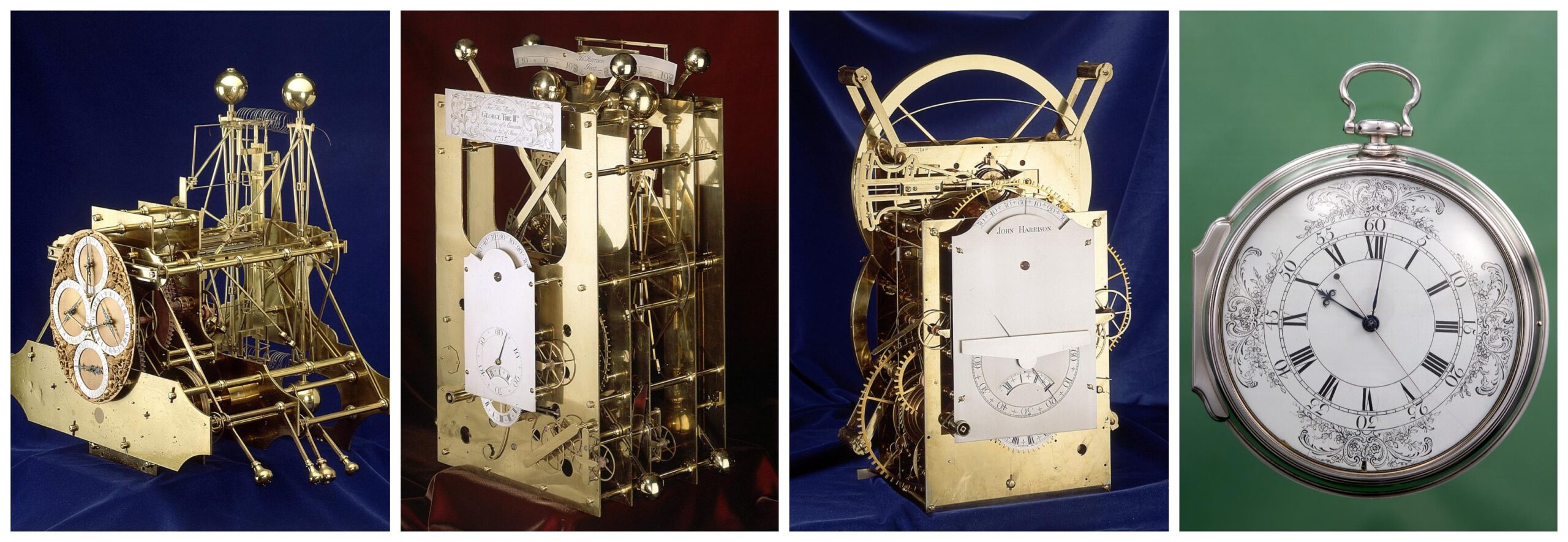
Born in Yorkshire and a carpenter by profession, John Harrison invented a mechanized timekeeping machine that solved this problem which he called a chronometer.  This device was, in a sense, the worlds first global positioning device.  In 1730 he began working on his first prototype which he called H1.  The project took him over five years to complete and he presented his device to the Board of Longitude in 1736.  He was granted a sea trial – the first given by the board – and the device performed well.  He was award small grant for further development and Harrison set to work on his H2 device.

A series of Marine Chronometer devices made by John Harrison - H1 to H4
A series of Marine Chronometer devices made by John Harrison – H1 to H4

Over several years Harrison further refined his sea clock in the form of his H2 and H3 devices, but came to realize the device was fundamentally flawed.  He shifted gears and went from making a sea clock to a sea watch.  He realized that some watches would keep time as accurate as his larger sea clocks and were much more practical for sailing.  This lead to his most famous device the H4, which kept nearly perfect time, was around five inches in diameter.  

Harrison’s H4 watch essentially was a large pocket watch that was wound daily.  It possessed a 30-hour power supply. The main technological breakthrough of all his devices was a spring driven mechanism that replaced the pendulum.  The smaller watch allowed for a higher frequency of the balance, making it more accurate than his clocks. Various combinations of metals were used in the watch to overcome the deleterious effects of humidity and temperature change.  The watch took six years to construct, was completed in 1759 and tested in 1761.  The watch passed the test with remarkable accuracy.  It lost a mere five seconds on an 81 day voyage to the West Indies and back.  After some wrangling Harrison was able to receive his prize from the British government for the design. 

Continue reading more about the exciting history of science!
James Watt

James Watt (1736 – 1819) vastly improved the Newcomen engine with a new steam engine of his own in 1781.  Watt’s improvements on the Newcomen’s engine provide one of the first significant examples of the application of cutting edge scientific research towards a technology that benefits society.

James Watt portrait
James Watt

Watt was born in Scotland, was the son of a shipwright, ship owner, and merchant and he never attended university because he was intended to take over the family shipping business when he grew older.  However when the family shipping business failed Watt traveled to London to learn instrument repair and returned to Scotland a year later where he eventually ended up working at Glasglow University as an instrument maker.   It was here that Watt began to experiment with steam power, and in 1763 Watt asked to repair a Newcomen engine from the university.

While fixing the Newcomen engine, which had been in use and remained largely unchanged in its design for over half a century, Watt noticed the huge inefficiency required to fully heat and then fully cool the entire massive cylinder at every stroke of the piston.  His insight was to create two chambers – one which was kept hot all of the time and one which was kept cool all of the time – that was connected by a valve that allowed steam to flow from the hot to the cool cylinder, where once it condensed would create the vacuum required to create the atmospheric pressure necessary to power the engine.  This change dramatically improved the efficiency and cost-effectiveness of the steam engine.  He also added subsequent improvements to his engine based on further experiments such as his double acting engine, which was a true steam engine as opposed to an atmospheric engine.

In 1769 Watt was able to patent his engine designs and he went on to have a successful commercial partnership with Matthew Boulton, an English manufacturer.   The Boulton & Watt steam engines were state of the art at the time and helped to advance the Industrial Revolution through their usage in factories and mills.  His legacy as a scientist and inventor is immortalized in the SI unit of power, the watt, being named after him.

Nicolaus Copernicus

Nicolaus Copernicus portrait
Nicolaus Copernicus

Nicolaus Copernicus (1473 – 1543) can be equated with the person who’s work began the Scientific Revolution in Europe in the sixteenth century.  Although people think of Copernicus as a scientist he was really more of an intermediary between the ancient philosophers and modern scientists.  He did not carry out experiments or make any meaningful observations of the heavens.  Instead he had an idea for a model of the universe that he believed was better than any previous idea, and it happened to turn out to be correct.

Copernicus was born in Torun, a Polish town, and was the son of a wealthy merchant.  He eventually moved to Italy where he studied in universities there and was influenced by the humanist movement occurring at the time.  It was there he read a book by a German mathematician known as Regiomontanus called Epitome of the Almagest, where inconsistencies of the Ptolemaic model were pointed out.  This created doubt in Copernicus’ mind about the accuracy of Earth centered Ptolemaic model of the universe and he began to formulate an outline of a heliocentric model when he had mostly complete by 1510.

Copernicus’ model was much simpler than the Ptolemaic model in that it eliminated the need for the many cumbersome equants, epicycles, and deferrents needed to make the model work.  Despite its elegance, Copernicus delayed in publishing his work until the year that he died in 1543 when he published On the Revolution of the Celestial Spheres.  His delay in publishing was probably due to fear of criticism.  While it did provide a workable model of the universe it also raised many questions (both theological and physical) that Copernicus would have had no way of answering.  It was because of these questions that the Copernican model took almost a century to become widely accepted when the invention of the telescope proved inconclusively that his model was correct.

1712: The Newcomen Engine

In 1712 Thomas Newcomen unknowingly ushered the world into the industrial revolution when he built an “atmospheric” engine to pump up water from a coal mine near Dudley Castle in England.  The Newcomen engine, as it came to be known, can thus be considered one of the most influential inventions in all of history.

A Novel Solution to a New Industrial Problem

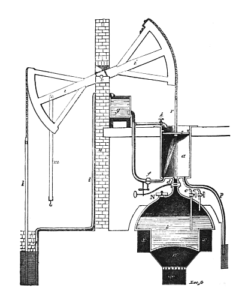
The Newcomen Engine
The Newcomen Engine

The demand for coal was steadily increasing in the early 18th century and coal miners were having to dig deeper and deeper into to ground to gather it. Flooding of these ever deeper coal mines was becoming a problem to the point that manual and horse powered pumping was becoming an inadequate solution. At the dawn of the industrial revolution, and industrial machine was needed to solve the problem.

An ironmonger named Thomas Newcomen by combining ideas of various precursor engines. About a decade earlier an English inventor named Thomas Savery patented a steam powered pump which was not technically an engine because it had no moving parts. At around the same time the French physicist Denis Papin was conducting experiments using steam cylinders and pistons. Newcomen combined these ideas to eventually solve the problem by inventing the world’s first practical fuel-burning engine in 1712.

The Newcomen engine was a large, lumbering, and inefficient engine that did its work not by the power of steam but by the force of atmospheric pressure.  The discovery of the vacuum in the prior century showed the power of atmospheric pressure and this principle was utilized in the Newcomen engine. This engine was a very complex device despite being predicated on rather simple principles. Its basic method of operation goes as follows. A boiler created the steam that was pumped into a cylinder where the steam was then condensed by cold water. This process of heating and then cooling created a vacuum inside the cylinder.  The resulting atmospheric pressure created inside the cylinder forced a piston downward, pulling the pump upward and thus removing the water out of the mine.  The boiler created more steam pushing the piston upward where more cold water was introduced into the cylinder and the cycle was repeated around twelve times per minute.

Searching for Improvements in Energy Efficiency

What the Newcomen engine possessed in revolutionary status it lacked in efficiency.  The engine was highly inefficient and originally only used in coal mines where a power source was abundant and nearby.  However despite the engineering drawbacks its usefulness proved quite valuable – over 75 were built during Thomas Newcomen’s lifetime and over 1000 were in use by the end of the century.  They quickly spread across most of Europe and to America. The problem with the engine continued to be in its lack of efficiency. It was becoming difficult to operate in area’s where coal was expensive or in low supply.

Still, the Newcomen engine remained largely unchanged and in wide use for most of the 18th century. These engines saw an efficiency improvement later in the century by James Watt. In 1764 Watt was repairing a Newcomen engine when he became fixated on the amount of coal needed to operate the engine because it wasted so much heat. After mulling over a solution for some time he realized that much of the inefficiency had to deal with the heating and the cooling of the steam in the cylinder. He concluded that it would be much more efficient to keep the cylinder heated about boiling points at all times and to have a separate condenser for cooling. In 1769 he acquired a patent for his new device and soon after entered into a partnership with Matthew Boulton. The Boulton & Watt steam engines quickly became the best in the world. Later on Watt designed a double acting steam engine by allowing steam to enter the cylinder at both ends providing for both up and down power strokes. This was now a true steam engine.

Impact of the Newcomen Engine

The invention of the Newcomen engine marked the beginning of the Industrial Revolution. Prior to the Newcomen engine most power was supplied by natural sources such as wind, water, and human and animal muscle. The newcomen engine and the subsequent improvements made by James Watt paved the way for steam powered transportation in the form of boats and railroads. Electricity and the internal combustion engine would eventually replace powering engines for transportation in the 20th century, but even to day we still most of our electricity from steam powered turbines.

Continue reading more about the exciting history of science!