On September 5th, 1977, a spacecraft weighing less than a ton lifted off from Cape Canaveral, Florida and began a journey with no return. The first of two missions, Voyager 1 would encounter worlds no human had ever seen up close, and travel farther than any human-made object in history – eventually leaving the Solar System and heading into interstellar space.
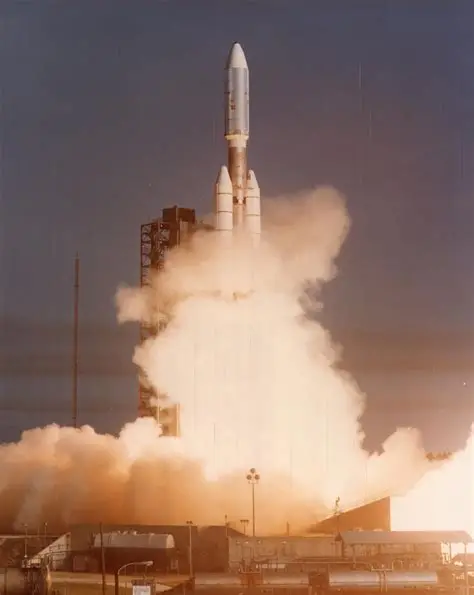
Launched in 1977, the Voyager program was an ambitious mission designed to explore the boundaries of the Solar System and beyond. Voyager 1 first major destination was Jupiter, where it reached in 1979. It provided detailed observations of Jupiter’s atmosphere, magnetic field, rings, and moons. The following year it reached Saturn where it observed its rings and numerous moons and made a particularly close encounter with Titan. The spacecraft continued its journey away from Earth and in 2012 it crossed the heliopause and entered interstellar space, becoming the first human-made object to accomplish that incredible feat. Voyager 1 also carries on of humanity’s most remarkable messages: the Golden Record. This record contains images, music, natural sounds, and greetings representing various human cultures and was included on the spacecraft for the unlikely possibility that an alien civilization might someday find it.
The launch of Voyager 1 represents one of the greatest triumphs of science. Centuries of discoveries in a multitude of scientific disciplines gave humanity the capability of constructing a machine capable of traveling billions of miles to the edge of the Solar System and beyond. It’s a testament to what we can accomplish when curiosity is combined with the scientific enterprise.
Another day, another discovery. Browse the On This Day Archive.