The belief among many Christians is that the Gospels of the New Testament provide an accurate account of the life, ministry, and death of Jesus. But the dating of the actual writings of the four Gospels throws this idea into serious doubt. The truth is the Gospels were written decades after the death of Jesus that contain historical elements embedded with mythical stories of his life.
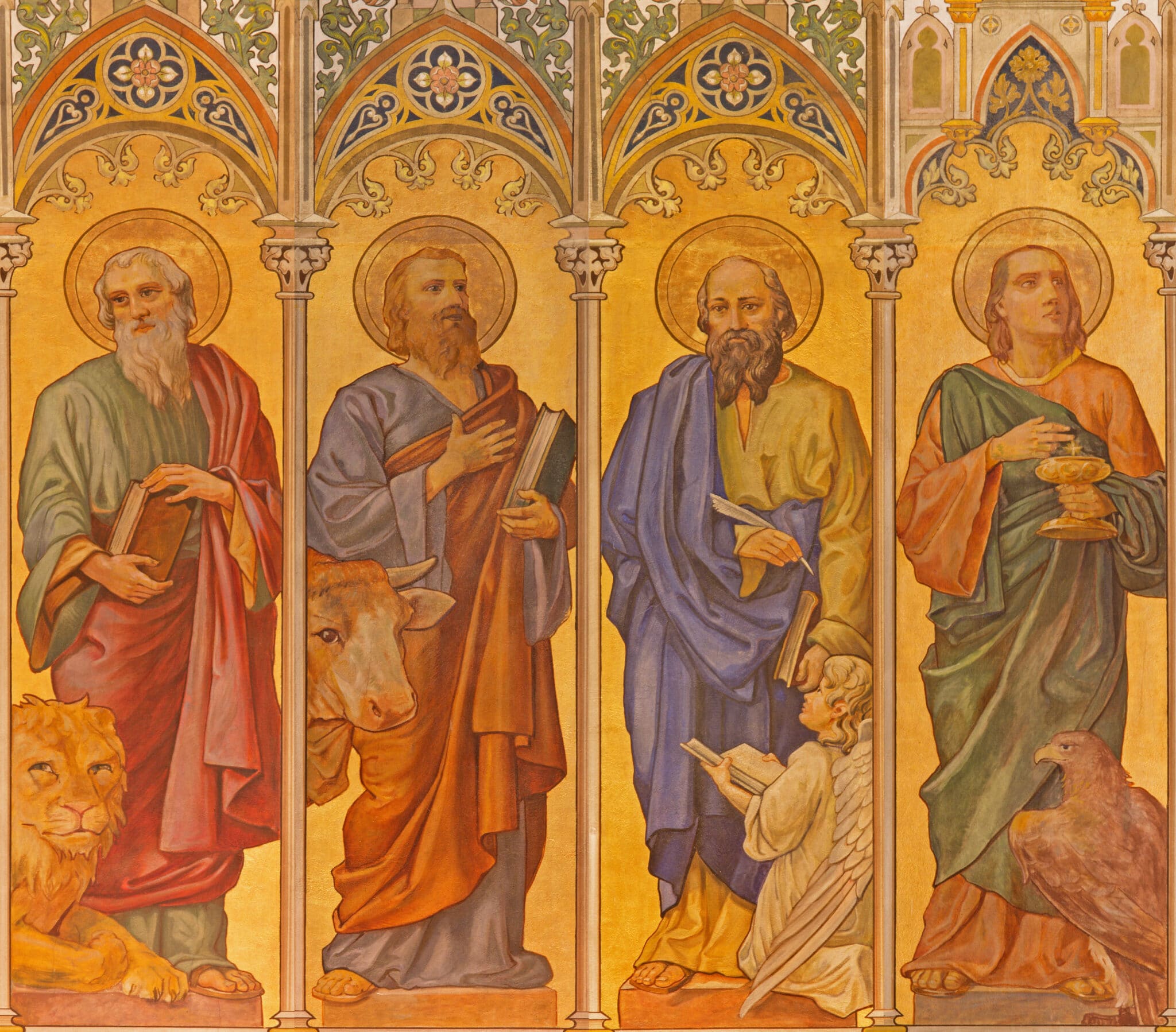
The Gospel According to Mark
The Gospel of Mark is the earliest written Gospel, and the best estimate is it was written around 70 CE. There are several lines of evidence to suggest this date. To begin with, it contains knowledge of the destruction of the Temple in Jerusalem, which occurred in the summer of 70 CE. The Gospel of Mark represents an early church leadership structure with an under-developed theology compared to that found later Gospel writings. Jesus is primarily depicted as an apocalyptic prophet and a suffering Messiah rather than the fully divine Son of God who is one with the Father.
We also know it was written before Luke and Matthew because each copies a significant amount of their Gospel from Mark. Matthew reproduces roughly 90% of Mark’s verses, while Luke preserves about two-thirds of them. In many cases, the wording is virtually identical. If the three Gospels represented completely independent eyewitness accounts, we would expect them to describe many of the same events but in their own unique language. Instead, entire paragraphs appear nearly word for word. The simplest conclusion is that both authors had a copy of Mark before them and used it as one of their primary written sources. Based on the above evidence, the Gospel of Mark fits in nicely as the earliest written Gospel with a date of about 70 CE – a full 40 years after Jesus’s death.
The Gospel According to Matthew
It’s fairly simple to provide a hard upper and lower limit when dating the Gospel of Matthew. We know it is written after Mark, providing a lower limit of around 70 CE. Ignatius of Antioch seems to be familiar with this Gospel, providing an upper dating limit of around 100-110 CE. The consensus of modern scholars is around 80-90 CE. This places it as written roughly 50 to 60 years after Jesus’s death.
As with the Gospel of Mark, the Gospel of Matthew contains knowledge of the destruction of the Temple in Jerusalem. It represents a more advanced church structure and theology than the Gospel of Mark, adding emphasis on Jesus as a divine authority. Mark was also used as a primary source when writing Matthew. Approximately 90% of Mark’s verses appear here, many times word for word. The only way to have large sections in word for word agreement is if it was copied.
The Gospel According to Luke
The Gospel of Luke was written about the same time as the Gospel of Matthew. The lines of evidence used to date it are also similar to Matthew. It contains knowledge of the destruction of the Temple of Jerusalem, it uses Mark as a primary source, and it contains a similarly advanced church structure and theology. Luke also begins by acknowledging that “many have undertaken to compile an account” before him. Rather than claiming to be an eyewitness, the author describes gathering traditions and written sources into an orderly narrative.
The Gospel of Luke is universally acknowledged as written by the same author as the Acts of the Apostles. The Acts describes the rapid expansion of Christianity through the Roman Empire, leading to the conclusion that the two-volume work was composed around 80-90 CE.
The Gospel According to John
The Gospel of John was the latest Gospel to be included in the New Testament, written around 90-100 CE. John’s Gospel is markedly different from the previous three. It includes a far more developed theology, suggesting decades of theological reflection within the early Christian movement. Jesus openly declares his divine identity, a theme that was completely absent in the earliest Gospel of Mark. John also refers to Judaism as “the Jews”, reflecting a sharp distinction between the Jewish and Christian communities. During Jesus’s life and shortly after his death, this distinction did not exist as Jesus and his followers were considered a sect of Judaism.
The Gospel also presents a highly developed understanding of Jesus as the eternal Logos (“Word”) who existed before creation. This philosophical language shows the influence of decades of theological development and interaction with the wider Greco-Roman world.
Conclusion
Taken together, the four Gospels show a clear historical progression. Mark is the earliest and simplest account. Matthew and Luke build upon Mark while expanding both the narrative and the organization of the early church. John represents an even later stage, presenting a far more developed theology and a Christian community that had become increasingly distinct from Judaism.
The chronological gap between Jesus’s death and the writing of the Gospels is significant. Mark was written roughly forty years later, Matthew and Luke about fifty to sixty years later, and John perhaps sixty to seventy years after the events it describes. During those decades, stories about Jesus circulated primarily through oral tradition before eventually being written down by anonymous authors.
None of this necessarily means that the Gospels contain no authentic historical memories. Ancient traditions often preserve elements of genuine events. However, it also does mean they should not be approached as contemporaneous eyewitness reports. Instead, they are theological narratives produced by later Christian communities for a Christian audience that sought to explain who Jesus was and what his life meant. Understanding when the Gospels were written is therefore essential for distinguishing between the historical Jesus and the beliefs that developed about him over the course of the first century.
Further Reading: Misquoting Jesus by Bart Ehrman, The Gnostic Gospels by Elaine Pagels