The hieroglyphics covering ancient Egyptian monuments spoke a language that nobody could understand. That changed on July 15, 1799, when a fortuitous discovery gave scholars the key they had been searching for. While strengthening the defenses of Fort Julien near the town of Rosetta, French soldiers serving in Napoleon’s Egyptian campaign uncovered a carved stone that initially looked ordinary enough. Yet that artifact, a large black basalt slab called the Rosetta Stone, became they key to deciphering the lost language of Egyptian hieroglyphics.
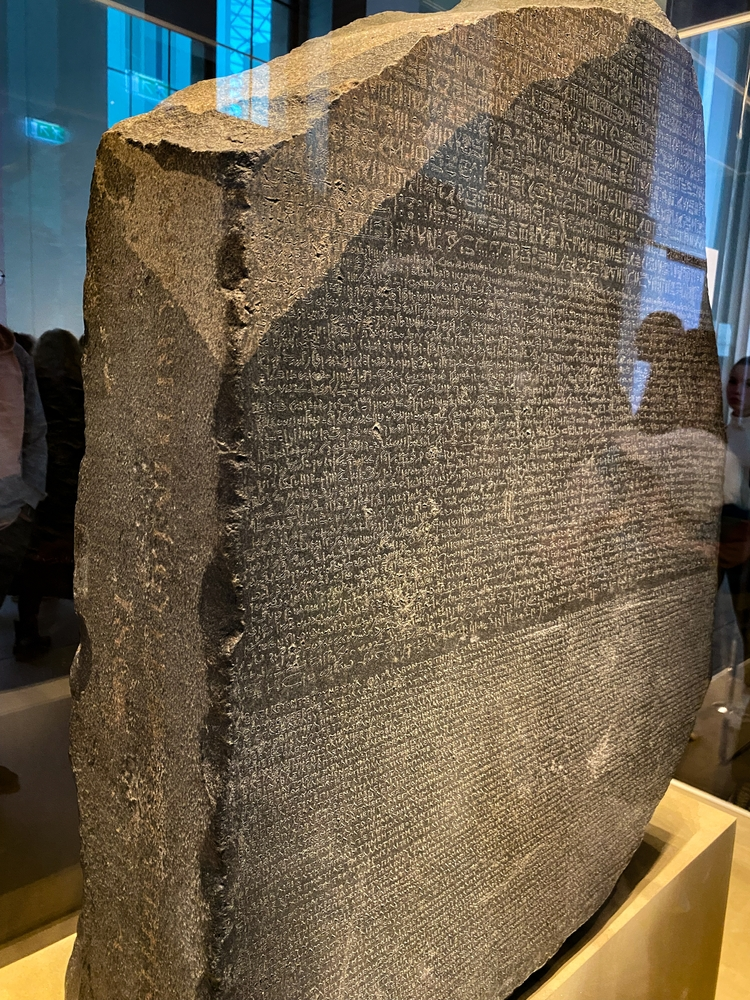
The Rosetta Stone contained on it a decree written in three different languages: Greek, Demotic, and Egyptian Hieroglyphics. Since the Greek language was known and could be read, researchers suspected the stone might serve as a translation key for the mysterious hieroglyphs. For nearly 1,500 years, no one could read the language of the ancient Egyptians. Their temples, monuments, and tombs were covered with elaborate symbols, but their meaning had been lost after the decline of the ancient Egyptian civilization. Some people even believed hieroglyphs were merely symbolic or mystical images rather than a true written language.
The breakthrough came in 1822 when French scholar Jean-Francois Champollion demonstrated that hieroglyphs represented both sounds and ideas, eventually unlocking the principles of the ancient writing system. Few archaeological discoveries have had such a profound impact. For the first time ever, historians could read the words carved onto Egypt’s temples, obelisks, and royal tombs, opening a window into more than three millennia of human civilization.
Another day, another discovery. Browse the On This Day Archive.