One of the key themes of this website is that everything is connected. Many times, people miss the forest – the big picture – for the single tree. But a forest consists of many different types of trees and other plants, which can determine which animals also live there. The climate also shapes the vegetation, the mountains shape the ecosystem, and changes in one part of the environment can ripple through the rest of the ecosystem. One of the first scientists to realize this was Alexander von Humboldt, born on September 14, 1769. He spent his life exploring the connections and relationships between climate, geography, geology, plants, animals, and human activity.
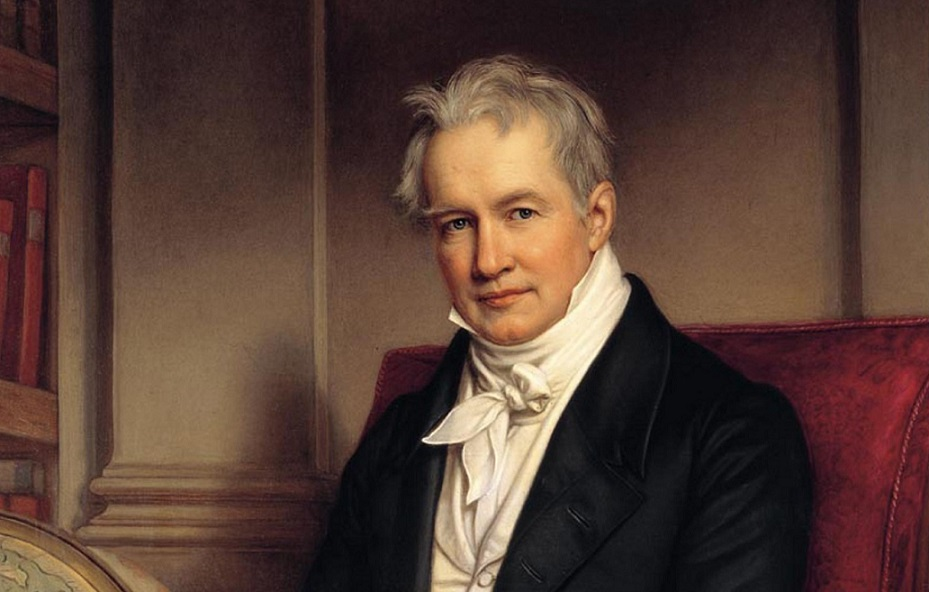
Alexander von Humboldt was born into a wealthy Prussian family, developed an interest in naturalism, and became intrigued by voyages and exploration. In 1799, with the French botanist Aime Bonpland, Humboldt set out on a five-year expedition through Latin America that would shape the rest of his life. The two catalogued thousands of plant species and took thousands of measurements of temperature, altitude, atmospheric pressure, magnetism, and other natural phenomena. Crucially, Humboldt did more than record data, he thinking in systems and looking for connections between them. Humboldt spent his later years writing up his findings and producing an ambitious multi-volume work called Kosmos as an attempt to describe the entire physical universe as a single, interconnected system.
Humboldt died in Berlin in 1859, just short of 90 years old. By then, his influence has spread, inspiring Charles Darwin and his voyage aboard the Beagle. Today, his insights sit at the heart of ecology and Earth-systems science. His great contribution to science is the realization that the world is not a collection of isolated phenomena, but a web of relationships to be understood. Sometimes, we have to stop looking at the individual trees and start seeing the forest.
Another day, another discovery. Browse the On This Day Archive.