The James Webb Space Telescope, NASA’s successor to the Hubble Space Telescope and the world’s most powerful telescope, was launched on Christmas Day of 2021. For months, astronomers knew the telescope was working, but nobody outside a small group of scientists had seen what it was capable of. On July 12, 2022, the first full-color images from the James Webb Space Telescope (JWST) were finally released by NASA, to the delight of millions of people worldwide.
The images revealed stunning views of the Carina Nebula, the Southern Ring Nebula surrounding a dying star, Stephans Quintet of interacting galaxies, and the atmosphere of the exoplanet WASP-96b. The JWST observes the universe in infrared light, allowing it to penetrate clouds of cosmic dust, revealing parts of the universe that were previously invisible. Its primary mirror allows for more than six times the light collecting area than the Hubble telescope.
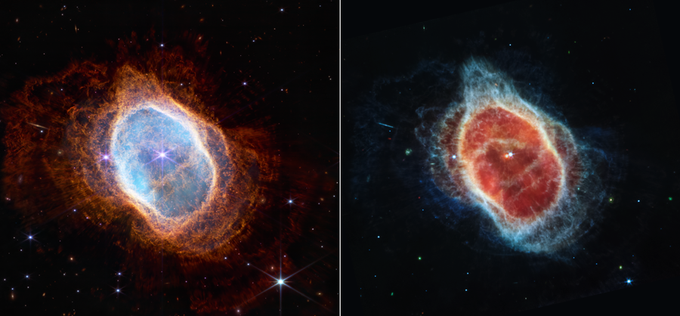
(Credit: NASA)
The JWST has to ability to transform our understanding of nearly every area of astronomy. It is currently being used to learn more about the formation of early galaxies and black holes, the birth of stars and planetary systems, and the atmospheres of distant worlds that may one day reveal life on another planet.
Another day, another discovery. Browse the On This Day Archive.