The history of science is filled with moments when new scientific discoveries collided and contradicted with long held religious beliefs. In many instances, science and religion have offered competing ways of explaining the natural world, beginning with Copernicus placing the Sun in the center of the Solar System. One of the most contentious areas of disagreement is in the origin of species, with science championing Charles Darwins Theory of Evolution by Natural Selection and religious fundamentalism championing Creationism. On July 21, 1925, that conflict came to a head during the Scopes “Monkey Trial,” when high school biology teacher John T. Scopes was found guilty of violating the Butler Act in Tennessee by teaching that humans evolved from earlier species.
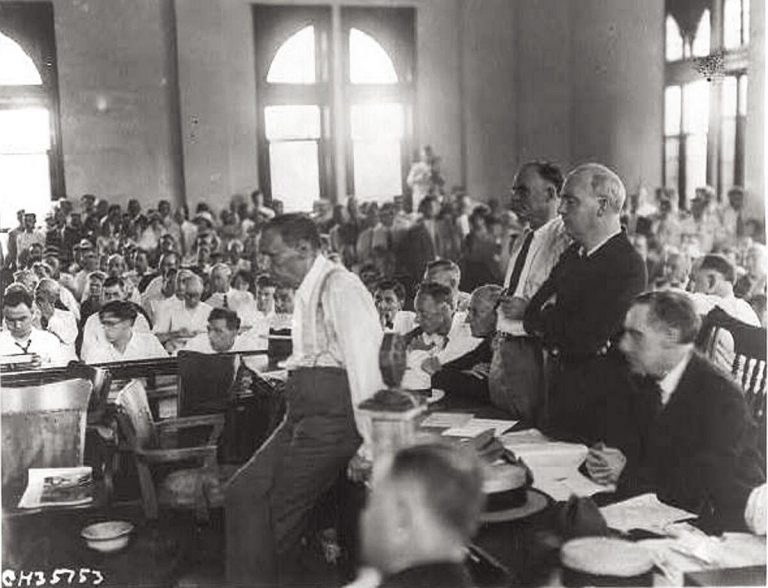
The case drew nationwide attention in what became showdown between science and religion. Hundreds of journalist covered the courtroom proceedings and it become one of the first cases to be broadcast over the radio, fueling the national spectacle it was rapidly becoming. Arguing for the prosecution was William Jennings Bryan, a three-time presidential candidate and outspoken Christian fundamentalist. Clarence Darrow, a celebrated trial attorney with a passion for free inquiry, represented John Scopes.
Scopes was ultimately found guilty and fined $100, although the conviction was later reversed on a legal technicality. The Butler Law as eventually repealed by the state of Tennessee in 1967, and the following year the Supreme Court ruled that banning the teaching of evolution is unconstitutional. The verdict against John Scopes did not stop the progress of evolutionary science. Over the following century, discoveries in genetics, molecular biology, and paleontology provided overwhelming evidence for evolution, making it the foundation of modern biology.
Another day, another discovery. Browse the On This Day Archive.