This extensive timeline provides a brief overview of the major developments and key figures in the exciting history of science, highlighting the progression of human knowledge and understanding of the natural world over the millennium.
At some point in history there had to be one initial crucial step that separated humans from the other animals in our journey to becoming the dominant species on this planet.
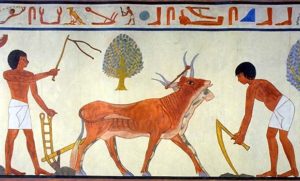
Domestication is the process of selective breeding for human use. The domestication of animals began with the now-lovable dog by at least around 14000 BCE and possibly thousands of years earlier.
The importance of metallurgy to human culture is so vital that scholars typically divide ancient time periods by metalworking ages such as the Stone Age, the Bronze Age, and the Iron Age.
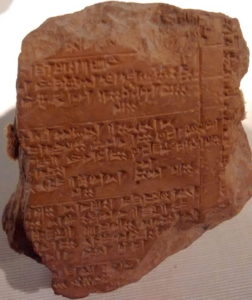
Writing is a set of markings used to represent a language. It augments the benefits of language by making permanent, allowing the message to travel further and persist through time.
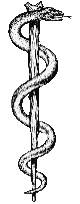
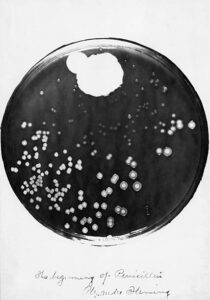
Disease is humanity's oldest and most feared enemy. It harasses us constantly in a multitude of vicious ways through methods that have only recently been discovered.
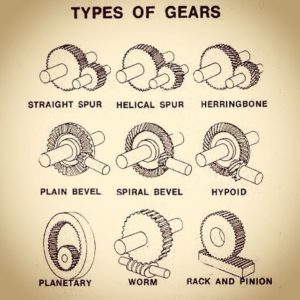
An important technology in allowing people do to work was the invention of the gear, a system consisting of cogs that takes energy from an input source, such as flowing water, and convert it to an output source, such as a pump.
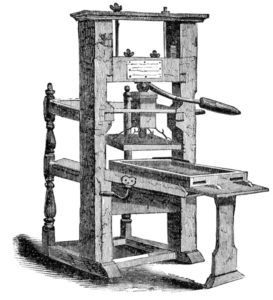
A vital precursor to the scientific revolution, the invention of the printing press changed the way information spread across the world by improving its fidelity and, most importantly, by hastening its rate of reproduction.
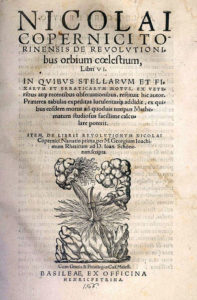
The Earth-centered universe was the prevailing wisdom of Medieval Europe until a Polish scholar named Nicolaus Copernicus suggested otherwise in his 1543 book, On the Revolutions of Celestial Spheres.
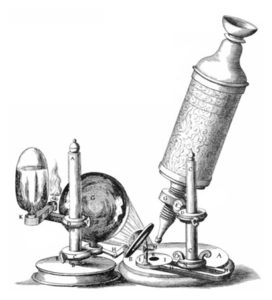
Like many inventions, the exact date of the first microscope is disputed and confused, however credit is sometimes given to Zacharias Janssen and his father Hans Martenz for creating the first microscope as early as 1590, or possibly in 1595.
In 1600 the English physician William Gilbert published “De Magnete”, a pioneering six volume treatise on magnetism and electricity that was the culmination of his eighteen years of study and experimentation.
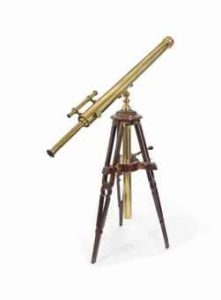
The first evidence for what later was to be called the telescope was the submission of a patent to the Dutch government in 1608 by Hans Lippershey, although it is likely that the idea was hit upon earlier by other lens makers.
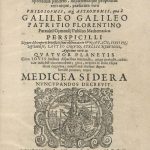
Published by Galileo Galilei on March 13, 1610, Sidereus Nuncius (or Starry Messenger) revealed to the world Galileo’s observations as he view the night sky through his improved telescope.
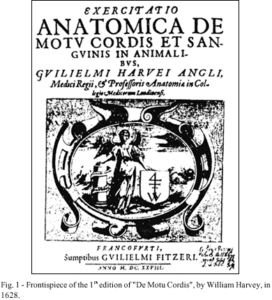
After thirty years of research, William Harvey’s landmark book On the Motion of the Heart and Blood in Animals established once and for all that blood flow was entirely circular and that the heart was a pump.
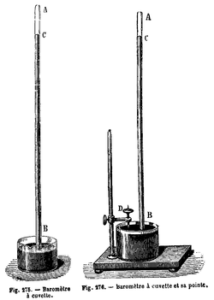
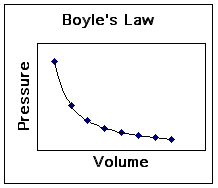
The existence of a vacuum, a space completely empty of matter, had been debated since at least the ancient Greek philosophers, and probably much longer.
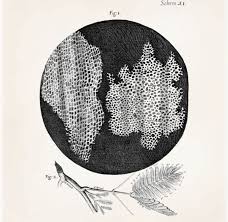
The observation of what was coined the cell by Robert Hooke in 1665 provided the starting point for a sequence of discoveries at the microscopic level and continuing into our present time that have revolutionized our view of life.
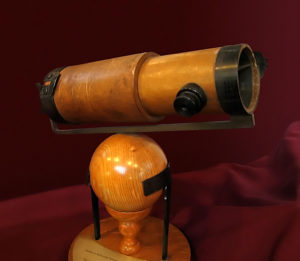
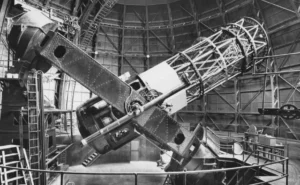
A refracting telescope uses lens to collect and focus the image as opposed to a reflecting telescope that uses a combination of mirrors to reflect and focus the image.
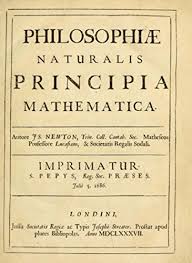
Issac Newton’s 1687 publication of Mathematical Principles of Natural Philosophy, more commonly known as Principia, may have been the most important and influential scientific piece of literature of all time.
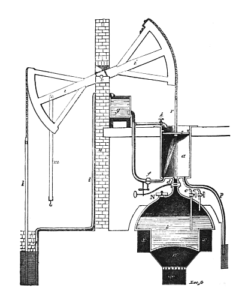
In 1712 Thomas Newcomen unknowingly ushered the world into the industrial revolution when he built an “atmospheric” engine to pump up water from a coal mine near Dudley Castle in England.
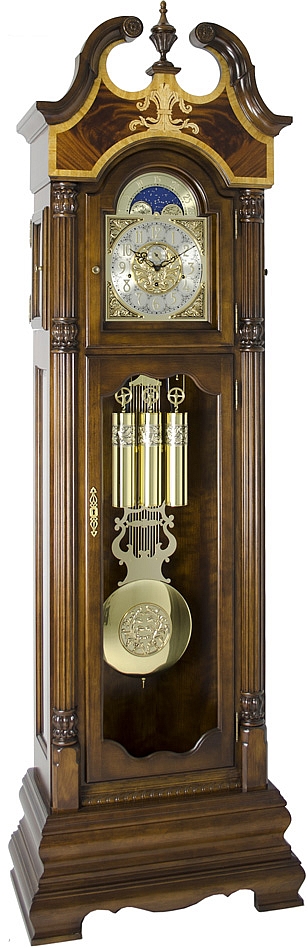
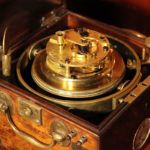
Amazing that it may seem to people living in the 21st century, finding reliable longitudinal position at sea was not possible until 1730 when John Harrison invented the marine chronometer, a timepiece capable of keeping accurate time of a known, fixed location.
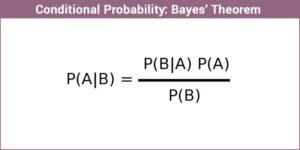
Bayes' theorem is a fundamental concept in probability theory. It was formulated in 1763 by the English statistician and Presbyterian minister, Reverend Thomas Bayes.
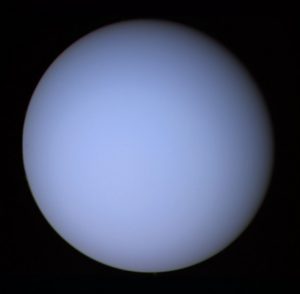
In 1781 William Herschel announced the discovery of a new planet that became named Uranus in the tradition of naming planets after classical mythology.
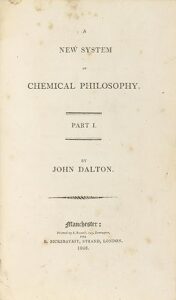
Dalton's atomic theory had a profound impact on the development of the emerging science of chemistry, and it laid the groundwork for many further scientific discoveries in atomic theory.
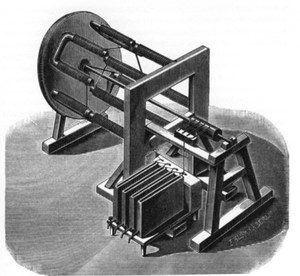
The invention of electric motor can be said to happened in May 1834 by Moritz Jacobi, although later that year Thomas Davenport independently created one as well.
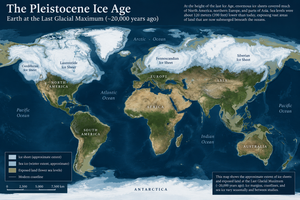
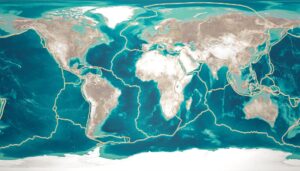
Enormous sheets of ice over a mile thick once covering much of North America is a basic fact of Earth science. However, the idea that Earth’s past climate was once drastically different from the climate we have today is a recent concept.
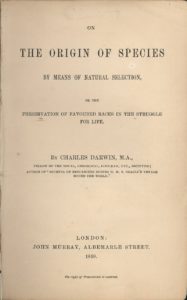
In 1859 Charles Darwin published his landmark book On the Origin of Species by Means of Natural Selection, or the Preservation of Favoured Races in the Struggle for Life.
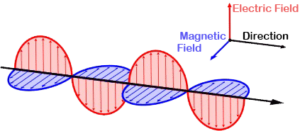
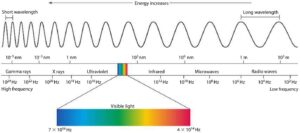
In nature there exists a continuum of radiation waves, all traveling at the same speed of light, with a nearly infinite possibility of wavelengths and frequencies. This is the electromagnetic spectrum.
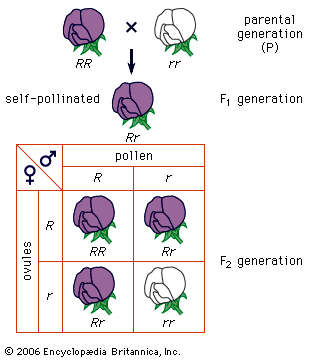
In 1866 the Augustinian monk Gregor Mendel published Experiments in Plant Hybridization that explained his pea plant experiments and the resulting laws of inheritance.
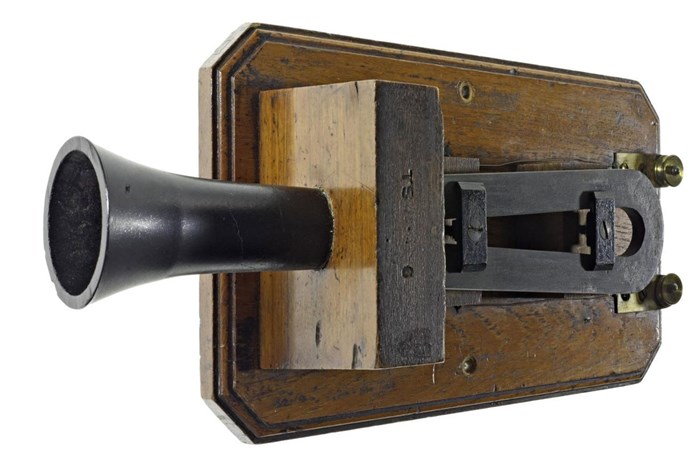
The story of the invention of the telephone one is a complex one, rife with rival claims over the invention itself, and the product of numerous discoveries and individual contributions. However credit is given to the Scottish born inventor Alexander Graham Bell who was awarded the first telephone patent in 1876.
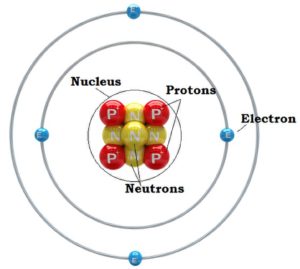
It was speculated for some time the atoms may be composed of additional fundamental units, and by the late 19th century evidence began to emerge from experimental research to support this hypothesis.
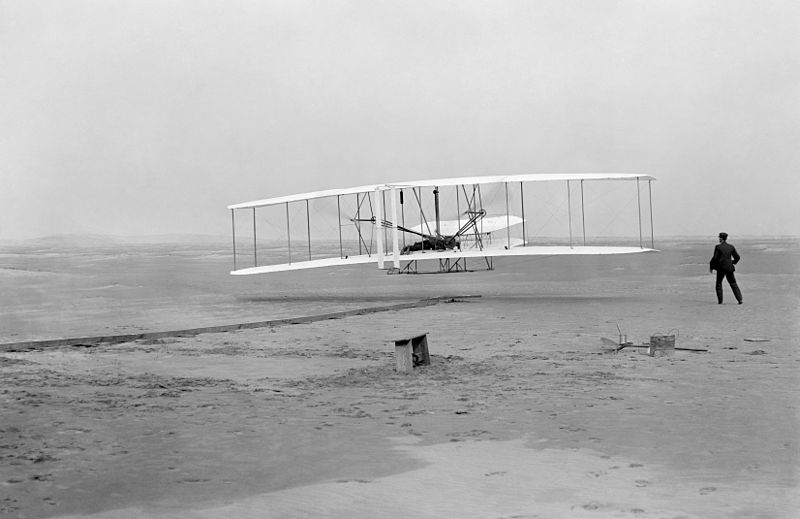
On December 17, 1903 just outside Kitty Hawk, North Carolina, Orville and Wilbur Wright completed the first successful sustained and controlled heavier-than-air, powered flight.
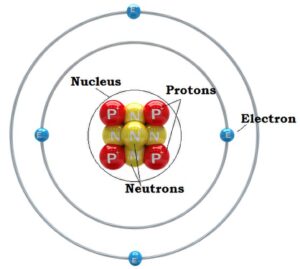
The discovery of the nucleus was the result of experiments conducted by Ernst Rutherford and his team, where a beam of alpha particles were fired at a thin sheet of gold foil.
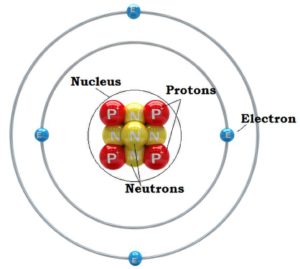
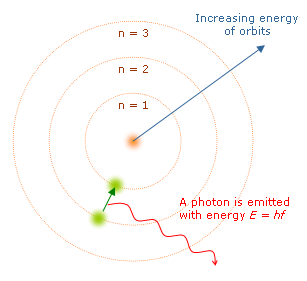
In 1913 Niels Bohr proposed a model of the atom based on quantum physics which helped solve problems of previous atomic models that were based on classical physics.
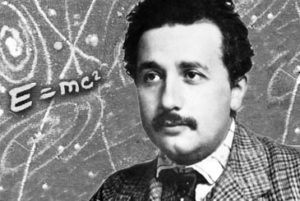
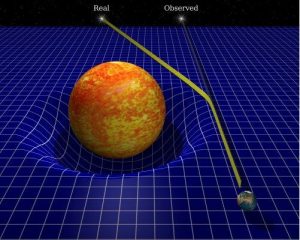
The theory of general relativity is one of the most profound and revolutionary achievements in the history of science and transformed our understanding of space, time, and gravity.
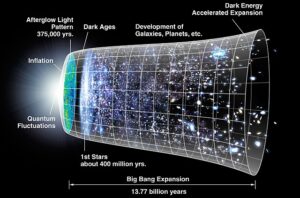
According to the Big Bang theory, the observable universe began in a singularity of infinite density and temperature at a specific moment in time some 13.8 billion years ago.
The discovery of Hubble’s Law by the American astronomer Edwin Hubble in 1929 added a significant piece of observational data in support of the expansion of the universe, a critical feature of the Big Bang Theory’s model.
The transistor was invented by John Bardeen, Walter Brattain and William Shockley of Bell Labs in 1947 as a replacement for the inefficient vacuum tube.
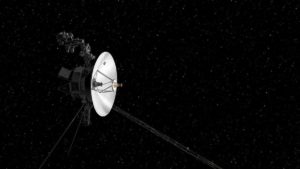
The Voyager Program consists of two spacecraft, Voyager 1 and Voyager 2, launched by NASA in 1977 in order to probe the four outer planets of the Solar System.
Such a cool timeline with interesting material available! I’m currently reading Sapiens by Yuval Noah Harari’s and this is so in line with the book hehe:)
Thanks for a really interesting post. History is very fascinating not least because history always repeats itself. Sadly we have always shown that we never seem to learn anything from the lessons of history.
The visual aspect of this is so useful. It puts into context how long some things have been around and how some have evolved. Will be poking around through the timeline. Thanks for sharing this!
This is a timeline that proves the superiority of the human race! However, with every power, comes a bigger responsibility! Now, we, as humans face a bigger threat of Climate Change, Terrorism and we all need to develop our mindset and technology to counter them! Maybe, you would need to modify this timeline to include climate change technology.


Fascinating timeline! I will definitely delve deeper into these, as it has sparked my curiosity. Surprised not to see anything past 1977.
Thanks for enjoying the timeline! Thanks for the feedback, I am working on updating more recent science.
wow. Great timeline. Fascinating to read about so many different facts
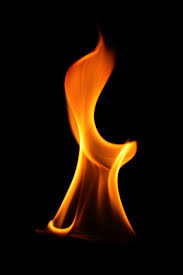
It’s amazing to see how far we’ve come since our early ancestors discovered fire!
i absolutely loved how you wrote out your post, the blocks makes it so easy to follow! cool post!
History is so amazing, there is always something new and fascinating to learn about our past.
I’ve always had a weird infatuation with science. Its always so intriguing to learn the power of science.
everything is science and science is everything. great timeline! I love the history. 👊
Love this very easy to follow timeline! good info! Thanks!
Very informative and interesting post with awesome compilation of timelines. Thanks for sharing
Wow – great post – a lot of data you heard at school but forgot already! Super informative!
For useful information. Thank you for this time line.
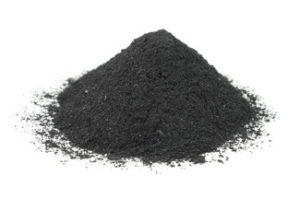
I miss learning about science! I had no idea when gunpowder or where it was first invented!
Interesting post. Thanks for sharing useful info.
This is fascinating! Wow, you made me stop on each mark, how many things. Great job!
Very informative, you know your stuff!
I don’t think I can appreciate this article enough! I am a huge science and fact nerd, I simply loved reading every piece. Thanks!
Such an interesting topic. I like how you formatted the blog post!
This is really cool to read and I like how you have it set up!!
Couldn’t stop reading the information given here. Great job!
This is very informative! My oldest loves Science and I imagine would love this timeline!
This is fascinating!!! Very well done! I love how you put everything that matters chronologically! So good.
I always love reading through these time lines and seeing the history of the earth
This is a comprehensive timeline going all the way back. Very interesting to read!
Such a great and very informative post. Honestly, I am not good at Science when I was studying bit this makes me interested
This is a great compilation and you have done a good bit of research!
This is an awesome timeline! I never knew when some of these major scientific things happened before!
What a comprehensive timeline! I loved the details & history of Science is so fascinating…isn’t it?
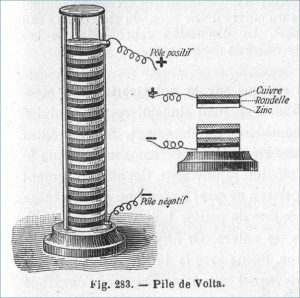
This is great! I found out several things that I didn’t know–such as batteries were first invented in 1799!
What an amazing timeline. I can’t wait to use this for a lesson Im teaching
Such a long list.. I didn’t know most of these, though I love watching and reading about science haha. Thanks for sharing.
Such an informative and interesting post. I love science so much. I really enjoyed reading this.
Great post, i really enjoyed reading this, so informative, I really loved science so it doesn’t bore me at all.. 😊
I love this layout and timeline great job!
This is so great to be able to have a quick timeline of our greatest scientific discoveries
Such a cool timeline with interesting material available! I’m currently reading Sapiens by Yuval Noah Harari’s and this is so in line with the book hehe:)
Hello Dan,
Thanks for a really interesting post. History is very fascinating not least because history always repeats itself. Sadly we have always shown that we never seem to learn anything from the lessons of history.
Best,
Pedro
I didn’t expect the first vaccination to date as far back as 1796. I thought it would be more recent
Amazing History of Science there. I got so hooked on them. wow.
This is super cool. I love the timeline and I really did learn some great info here.
I love reading your timelines. They give such a clear picture and make history easier to understand and follow.
So cool! Loved reading your article. Thank you! 😊
Great article! As a suggestion, you could add horseback riding.
This timeline is great! I cannot imagine how much research and time has gone into this. It’s fascinating!
The visual aspect of this is so useful. It puts into context how long some things have been around and how some have evolved. Will be poking around through the timeline. Thanks for sharing this!
This is an awesome timeline! I have book marked for future reference 🙂
This is so cool how you structured this! Very cool blog post. I am looking forward to reading more.
So cool, I loved the layout of the timeline. This was so very interesting to read. Thank you for sharing.
This is beyond interesting and beyond fascinating to me, wow!!! The timeline really puts everything in perspective, I love it.
Perfectly executed. This was so cool to read through!
This timeline is incredible! I thought it was fascinating that it took gunpowder so long to get to Europe!
It’s interesting that domestication of animals can before plants. I would have thought it would be the other way around.
This is a timeline that proves the superiority of the human race! However, with every power, comes a bigger responsibility! Now, we, as humans face a bigger threat of Climate Change, Terrorism and we all need to develop our mindset and technology to counter them! Maybe, you would need to modify this timeline to include climate change technology.
What a great compilation. A useful way to remind ourselves where we have come from with regard to science!
Love how you formatted everything. Makes it super easy to follow without getting overwhelmed . Great post!
this was so interessting to reead