For most of human history, traveling long distances has been arduous and slow. Only a little over 500 years ago, Christopher Columbus’s first trans-Atlantic voyage to America took around 36 days. But as science and engineering advanced, the world shrank. On July 22, 1933, aviator Wiley Post demonstrated this fact by becoming the first solo pilot the fly around the world. He accomplished his mission in 7 days, 18 hours, and 49 minutes.
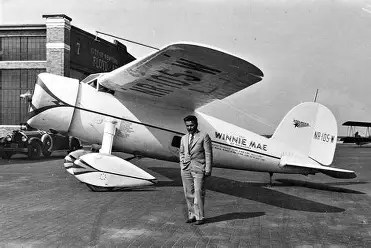
Wiley Post began his journey from Floyd Bennett Field in New York on July 15. He piloted a Lockhead Vega airplane named Winnie Mae through eight countries and across two oceans before returning to New York on July 22. Solo flying meant that there was no co-piolet to assist with navigation, monitoring the airplane, or help out during potential emergency situations.
His achievement was made possible by remarkable advances in science and technology. Radio communication, light-weight materials, improved aircraft engines, and more accurate navigational instruments allowed piolets to fly further and more safely than ever before. His flight proved that global flight was no longer an impossible adventure, but a practical reality. The ever-improving aviation technologies would lead to modern commercial air travel, connecting billions of people around the world.
Another day, another discovery. Browse the On This Day Archive.